

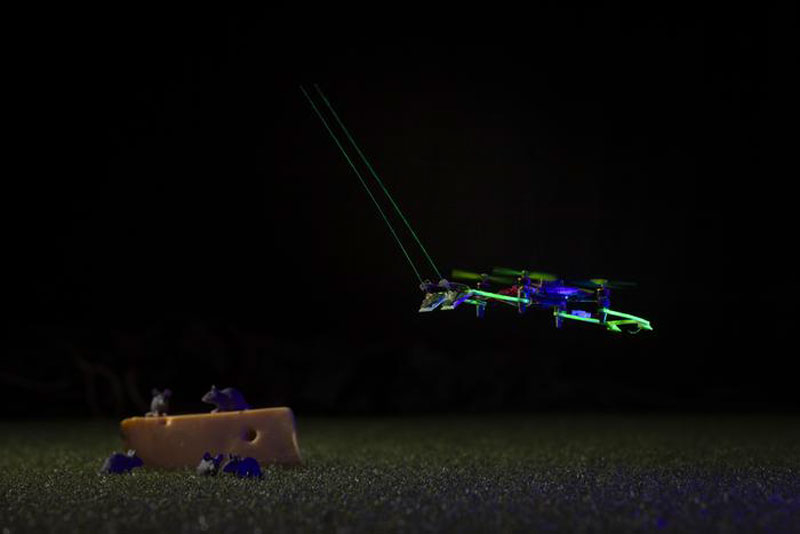
Researchers at the Delft University of Technology in the Netherlands have developed a tactile navigation system for drones weighing less than 100 grams. The system replaces traditional cameras and lidars with artificial whiskers, similar to those found on rodents, allowing drones to navigate through tight spaces like tunnels or debris-filled buildings.
The sensor array consists of two flexible whiskers mounted at the front of the drone. Each whisker features three pressure sensors at its base. When a whisker contacts a surface, the resulting pressure changes allow the system to determine the direction of contact, the proximity to the object, and the obstacle's position in space.
To ensure accuracy, the team created a controller and an algorithm that filters out vibrations from the drone's rotors and air turbulence. This allows the system to calculate distances to obstacles with millimeter precision. The entire processing pipeline runs on an onboard microcontroller using only 34 KB of memory.
During testing, the drones successfully navigated along various surfaces and followed wall contours in total darkness. The robots were able to create tactile maps of unknown environments and locate exits without relying on external positioning systems or visual sensors, proving their utility in smoke-filled or subterranean areas.

