

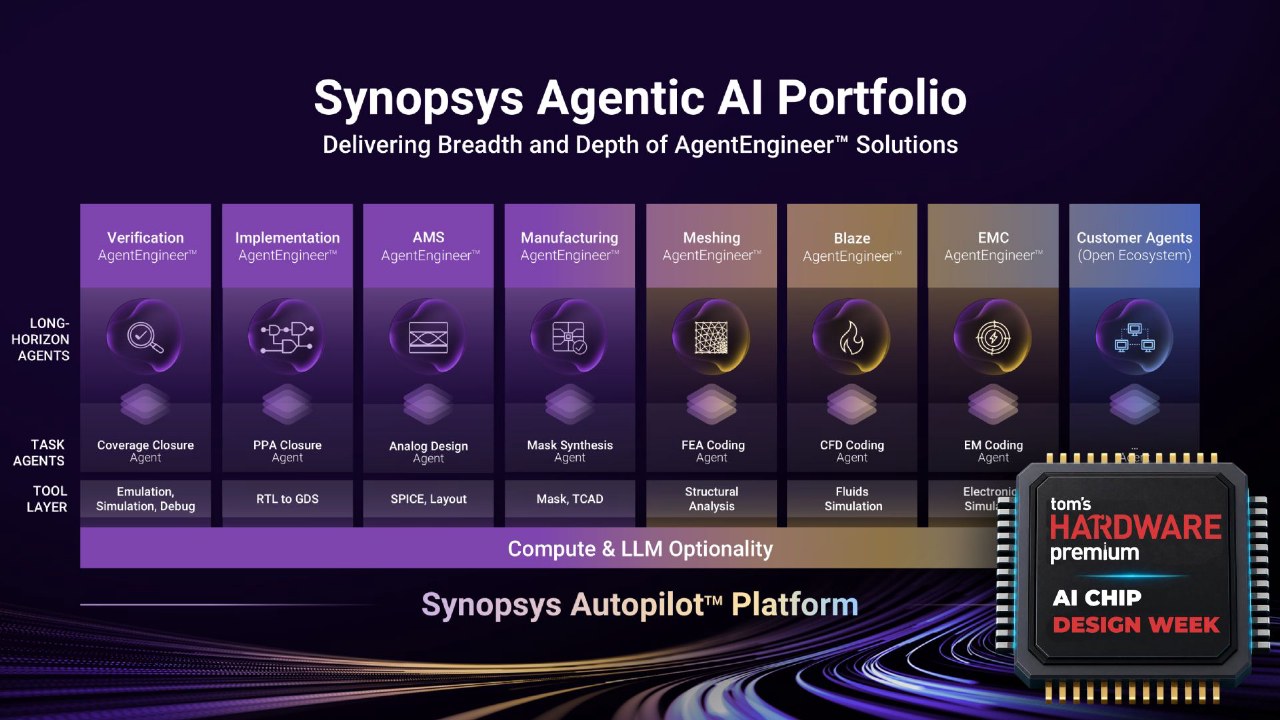
Synopsys has introduced its Autopilot platform, a suite of AI-driven agents designed to automate chip design workflows. The system is structured into three layers: long-horizon AgentEngineers for complex orchestration, task agents for specific engineering operations, and tool engines for execution. The platform supports deployment on Synopsys Cloud, private clouds, or on-premises infrastructure, allowing users to integrate their own models and data.
The company reports significant performance metrics, including up to 50x faster verification closure and 20% higher coverage, figures previously validated through work with Nvidia. Other reported gains include a 10% to 30% productivity boost, as noted by Fujitsu, and a 2x improvement in token efficiency. Synopsys classifies these agents as Level 5 autonomous, though human oversight remains mandatory through defined approval checkpoints.
Several industry players, including Intel, MediaTek, Samsung, and AheadComputing, have endorsed the technology. While Synopsys' previous tool, DSO.ai, has achieved over 100 production tape-outs since 2020, the new Autopilot agents are currently in the engagement phase. The company aims to reach general availability for the platform by the end of 2026.
The platform includes security features such as access controls and encryption to protect intellectual property. The verification loop allows agents to plan, execute, and perform root-cause analysis when bugs are detected. If results deviate from objectives, the system is designed to course-correct and adapt, though human engineers retain the ability to inspect results and redirect workflows.



