

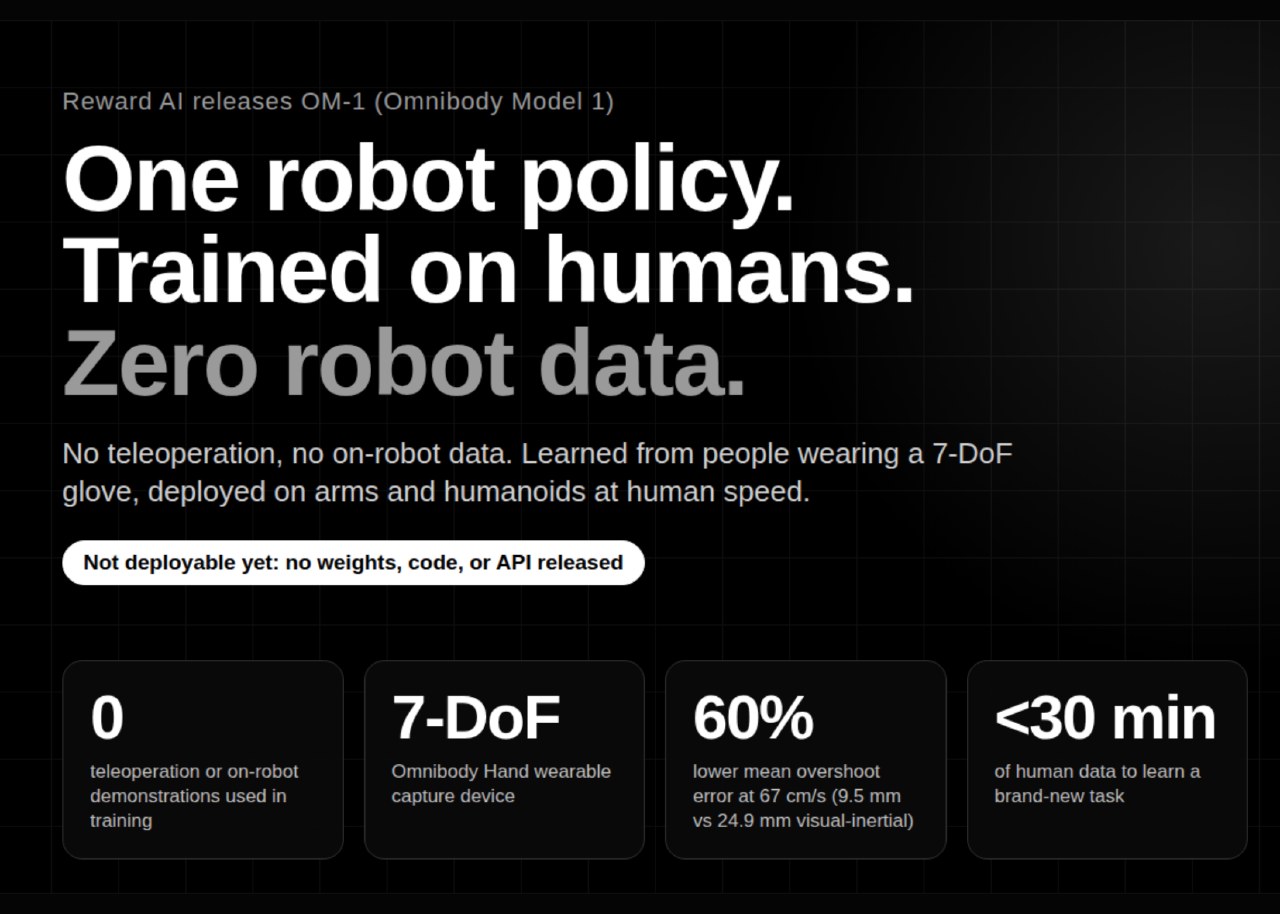
Reward AI has unveiled OM-1, an internal robot policy designed to learn directly from human demonstrations. The model avoids traditional training methods like teleoperation or data collected directly on robots, instead utilizing a unified pipeline for capture, learning, and control. This approach allows the system to train robot bodies that do not currently exist.
The hardware stack features the Omnibody Hand, a wearable motion capture device with seven degrees of freedom. It captures thumb-index pinching, flexion, and coupled finger motion. The device uses electromagnetic sensing to improve hand pose tracking, achieving a 60% reduction in mean overshoot error compared to visual-inertial tracking at speeds up to 67 cm/s.
The system processes multimodal data, including images, tactile signals, and proximity, at native sensor sampling rates. A reinforcement-learned control layer operates independently of the policy to manage dynamics and external disturbances. This allows robots to perform complex tasks, such as opening refrigerator doors or lifting objects of unknown weight, without stalling during inference.
Reward AI claims that OM-1 can master new tasks with challenging dynamics using less than 30 minutes of human data. The model is compatible with various embodiments, including arms, legged humanoids, and wheeled mobile manipulators. Currently, the policy is proprietary, and the company has not released code, weights, datasets, or APIs for public use.



