

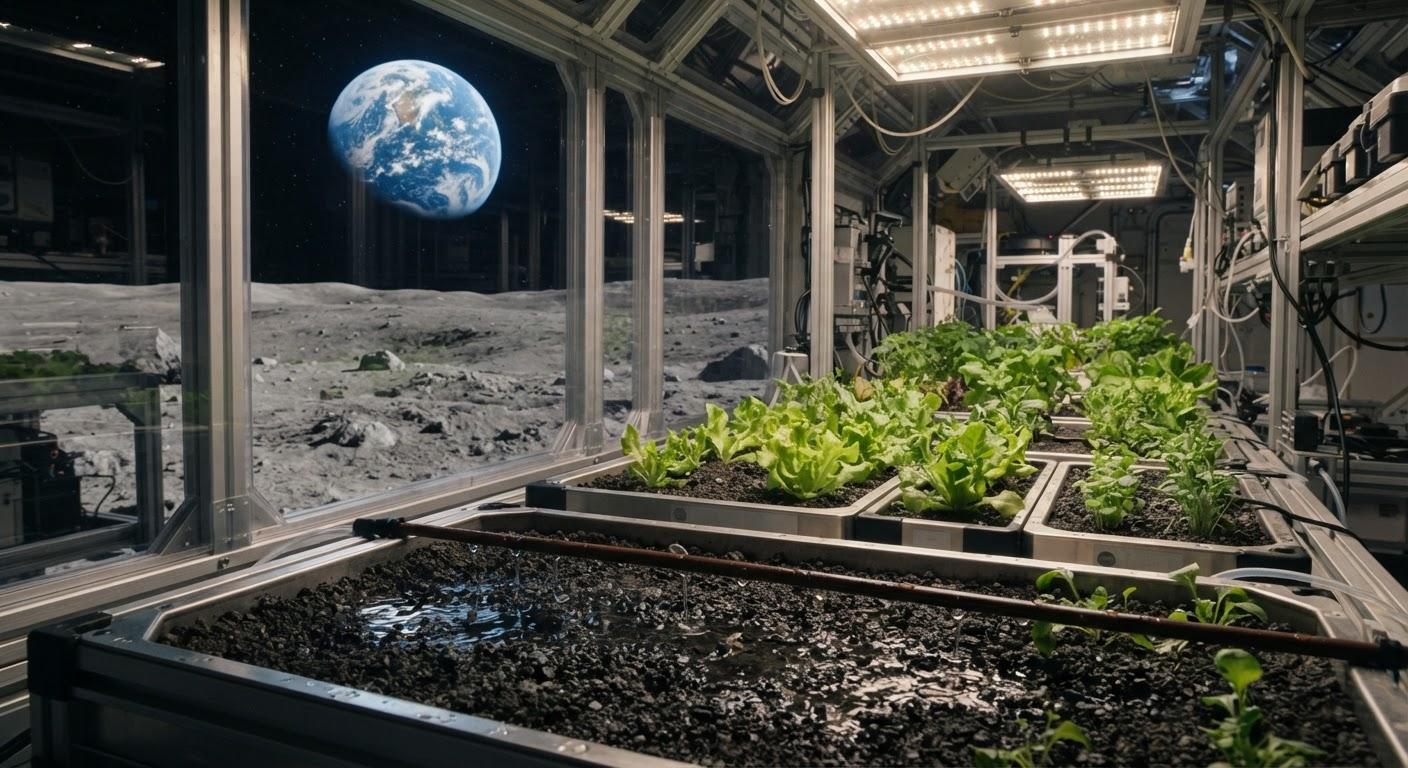
Researchers John Kiss, Karl Hasenstein, and Christopher McKay investigated how lunar gravity affects water movement for potential plant cultivation on lunar bases. The study focuses on how low gravity, which is approximately one-sixth of Earth's, increases the influence of surface tension on fluids.
The team conducted an experiment during a Blue Origin New Shepard 29 suborbital flight in February 2025. The flight provided about two minutes of lunar gravity conditions during a ten-minute mission. Scientists tested pure water, a saline solution, and a 30% glycerin solution to observe meniscus behavior.
The results confirmed that surface tension significantly alters fluid distribution compared to Earth. This suggests that standard irrigation systems will require modifications for lunar use. Additionally, the unique properties of lunar regolith combined with low gravity may complicate moisture and oxygen delivery to roots.
The 30% glycerin solution showed more favorable flow characteristics, suggesting that specific additives could help manage water behavior in space-based agriculture. Future research will involve longer simulations of lunar gravity, with the ultimate goal of conducting experiments directly on the Moon's surface.



