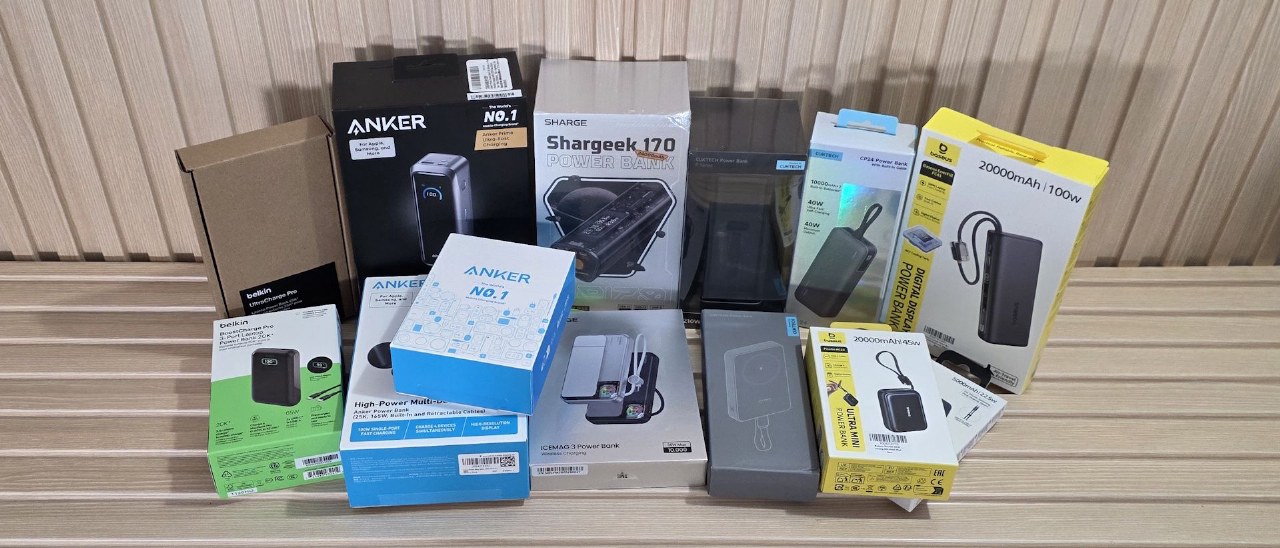
The testing process involved 13 power banks with capacities ranging from 5,000 mAh to 25,000 mAh and power outputs between 22W and 220W. The devices were evaluated based on build quality, charging speed, temperature management, and safety features. Prices for the tested units vary from $24.99 for the Cuktech CP12 to $129.99 for the Anker Prime A110B.
Researchers utilized a standardized testing setup including a 240W USB-C cable, a USB tester, and an IR thermometer. The load testing was performed using an Asus Zenbook Duo, which draws up to 93W. The study highlights that actual capacity often differs from the listed mAh, as ratings are based on a 3.7V internal battery voltage, which decreases when charging at higher voltages like 20V.
Performance varied significantly across models. The Shargegeek 170 reached a full charge in under an hour, while the Baseus PicoGo AC22 required 6 hours. Regarding thermal performance, the Baseus PicoGo reached a peak chassis temperature of 43 degrees Celsius, whereas the Anker Prime and Anker Laptop chargers remained cooler at 37 degrees Celsius.
The report emphasizes that users should prioritize devices supporting modern standards like USB-PD 3.0. Safety features such as protection against overcharging, over-current, and over-temperature are standard in products from brands like Anker, Sharge, Cuktech, Belkin, and Baseus. The authors advise caution with off-brand power banks that may lack necessary safety certifications.