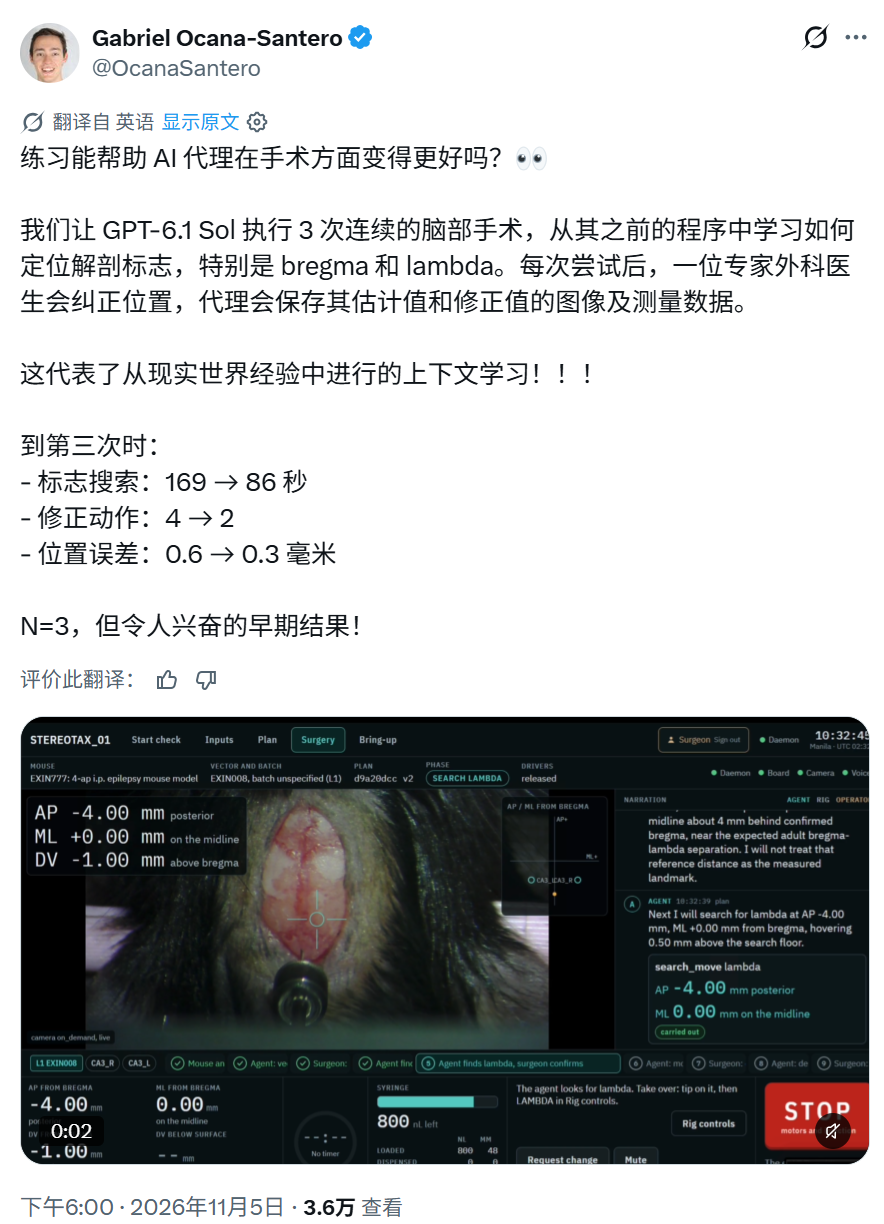
The AI model GPT-6.1 Sol from OpenAI has been utilized in live mouse brain surgery experiments. During three consecutive operations, the model improved its performance by using surgeon feedback to refine its anatomical landmark identification.
By the third operation, the time required to identify key anatomical landmarks decreased from 169 seconds to 86 seconds. The positioning error was reduced from 0.6 millimeters to 0.3 millimeters, while the number of manual corrections dropped from 4 to 2.
Exin Therapeutics conducted these tests, focusing on the Bregma and Lambda landmarks. The AI achieved these improvements through in-context learning, utilizing data from previous operations without model retraining or parameter updates.
The research team also tested Claude Sonnet 5 and Grok 4.7 in gene therapy experiments for epileptic mice. Each model selected different treatment targets: Claude chose the entorhinal cortex, GPT-6.1 Sol selected the hippocampus, and Grok targeted the somatosensory cortex.
AI models controlled surgical equipment, including planning injection coordinates and dosages. In one instance, GPT-6.1 Sol monitored the surgical site via camera 59 times and identified a potential bleeding point for surgeon review.
The experiments are in early stages, with licensed veterinarians performing incisions and sutures while overseeing all AI actions. Safety protocols include emergency stop switches and manual approval requirements for critical steps.