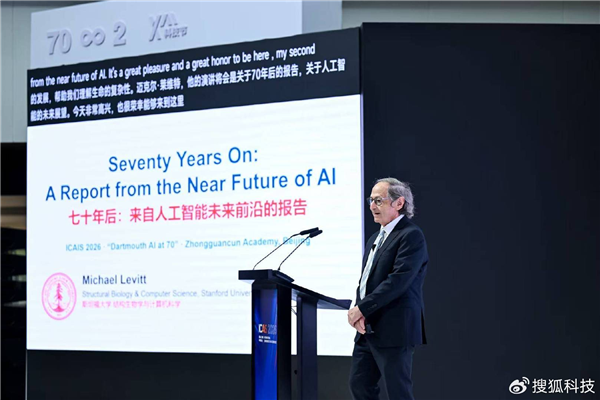
The second International Conference on AI Scientists (ICAIS 2026) recently took place in Zhongguancun, Beijing. During the event, Michael Levitt, a 2013 Nobel laureate in Chemistry and professor at Stanford University, discussed the impact of artificial intelligence on scientific research.
Levitt projected that by 2056, young scientists utilizing AI agents could accomplish in a single year the equivalent of an entire career's work for his generation. He suggested that this efficiency gain might even exceed a 30-fold increase.
The professor noted that AI could bridge the gap between experienced researchers and younger scientists by accelerating the translation of knowledge into action. He remarked that AI tools have revitalized his own research career.
Regarding AI safety, Levitt emphasized the importance of diversity in models. He argued that the coexistence of various systems, such as DeepSeek, Kimi, Claude, and ChatGPT, serves as a fundamental safeguard for the secure development of artificial intelligence.