Nio founder and CEO William Li announced that the company has deployed 4,125 battery-swapping stations. Each station acts as a distributed energy storage unit, collectively forming an 8GWh energy storage network capable of supporting both vehicle owners and the broader power grid.
The company successfully tested this model at its off-grid solar-storage-swapping station in Xingxingxia, Xinjiang. This facility demonstrates a closed-loop system where solar power is generated, stored locally, and used to charge batteries for vehicle swaps, proving the concept for remote regions.
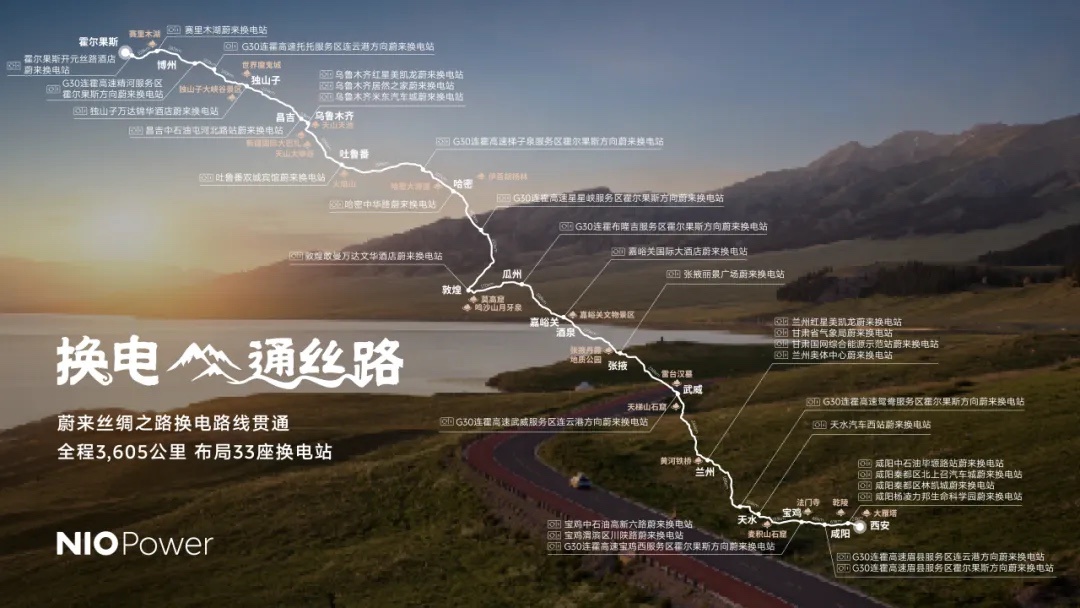
On September 26, Nio completed its Silk Road battery-swapping route with the launch of a station at Sayram Lake. The 3,605-kilometer corridor stretches from Xi'an in Shaanxi province to Horgos in Xinjiang, featuring 33 dedicated swapping stations along the way.
With the completion of this route, Nio users can now travel across all provincial-level administrative regions in mainland China using only the company's battery-swapping network. This infrastructure allows drivers to rely exclusively on swapping stations for energy replenishment throughout the country.