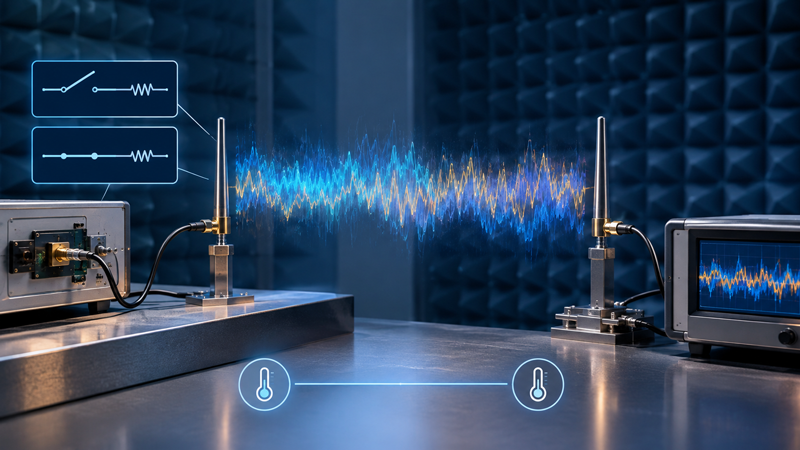
A team of US researchers has developed a wireless communication model that operates using thermal noise instead of traditional radio signals. This method transmits data by switching an antenna between open and closed circuit states, which alters its reflective properties and creates detectable electromagnetic variations.
The system does not violate the second law of thermodynamics, as energy is consumed for switching, encoding, and receiver operation. The researchers created a mathematical model to optimize the communication channel, which allowed them to increase data transmission speeds by 100 times compared to earlier tests.
This technology is suitable for environments where radio interference must be avoided, such as near medical equipment or in radio astronomy. The approach is highly energy-efficient, potentially consuming up to 1000 times less power than active radio signal transmission systems.