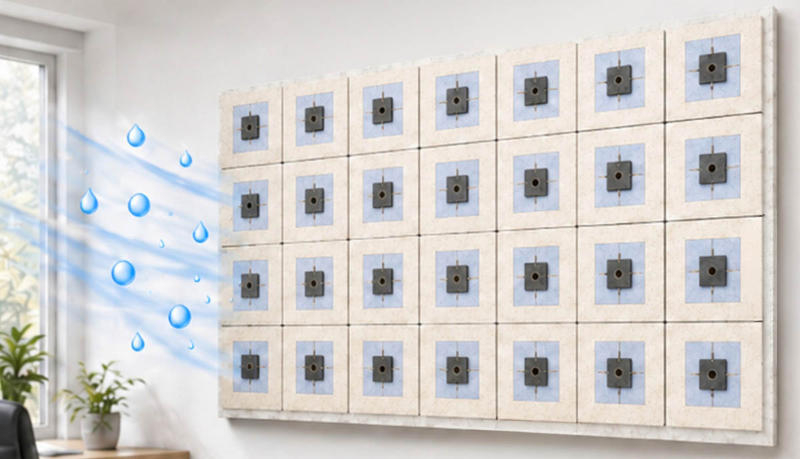
Researchers at Binghamton University have developed wallpaper capable of generating electricity by harvesting moisture from indoor air. Unlike outdoor generators, this technology benefits from the stable humidity levels found inside homes, typically ranging from 30 to 60 percent.
The wallpaper is constructed from 340-micron thick paper, utilizing a manufacturing process that includes wax and screen printing, spray coating, and laser processing. Each unit consists of 2 by 2 cm paper squares divided into three zones containing glycerin, polyvinylpyrrolidone, and wax to facilitate proton release.
Performance tests showed that a single element produces approximately 0.34 V at 80 percent humidity, while a chain of ten elements generates about 2.9 V. A larger array of 1,596 elements produced 3.5 V at 38 percent humidity, which was sufficient to power a wireless keyboard.
Beyond energy generation, the material acts as a humidity buffer. In testing, a 28-element array reduced humidity in a sealed chamber from 75 to 50 percent in four minutes. Researchers aim to use this technology to power sensors and IoT devices rather than replacing traditional power grids.