

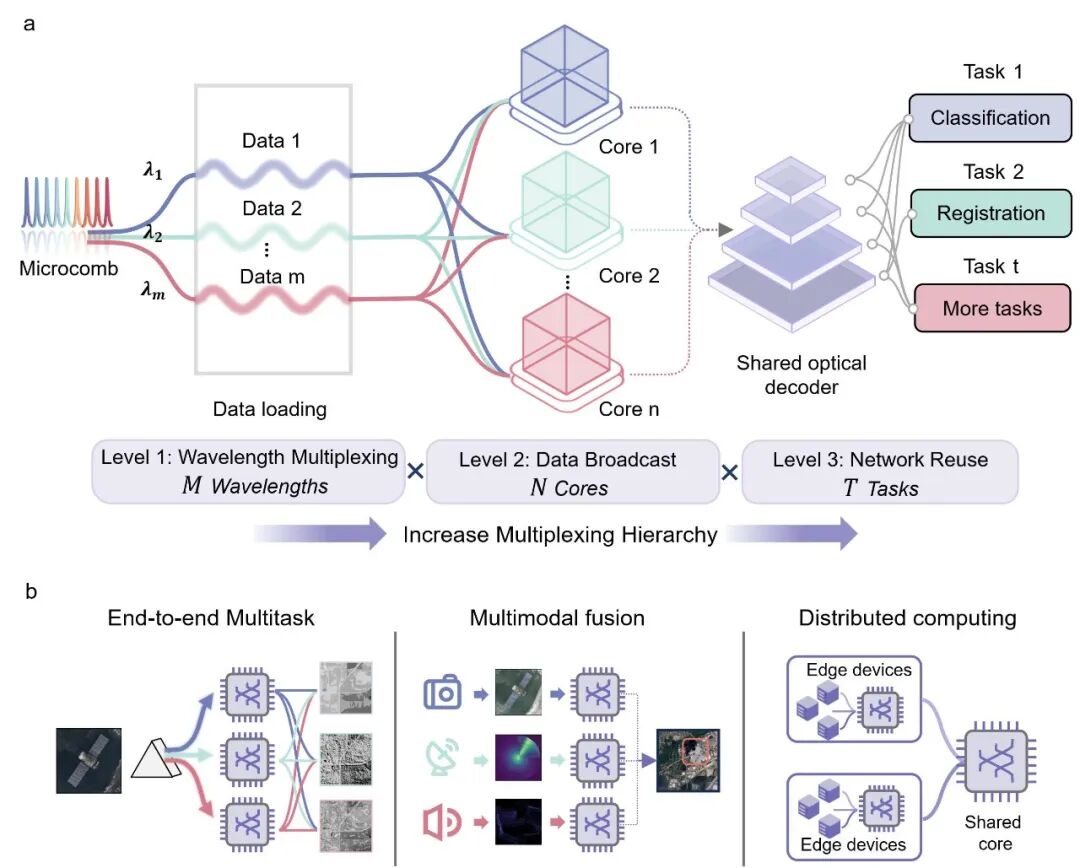
Researchers at the Shanghai Institute of Optics and Fine Mechanics, led by Xie Peng, have developed a new multidimensional multiplexing optical computing architecture. The study, published in Laser & Photonics Reviews, builds upon the team's previous work on the Meteor-1 ultra-high parallel optical computing chip.
The architecture integrates wavelength multiplexing, data broadcasting, and network reuse. It utilizes three independent optical computing cores, with each core supporting 108 wavelength channels. This configuration achieves a total parallel computing capacity of 324 channels and enables the sharing of matrix computing networks across two tasks.
The system processes multi-modal information in parallel by using different wavelengths to carry data. The team successfully performed image convolution tasks using operators such as Diagonal, Sobel-x, and Sobel-y. The root mean square error compared to electronic benchmarks remained below 0.08.
The researchers validated the architecture's performance through remote sensing image registration and recognition tasks. The system achieved an accuracy rate of 84.5 percent. This work demonstrates the feasibility of expanding optical computing power through parallel processing across wavelength, spatial, and task dimensions.