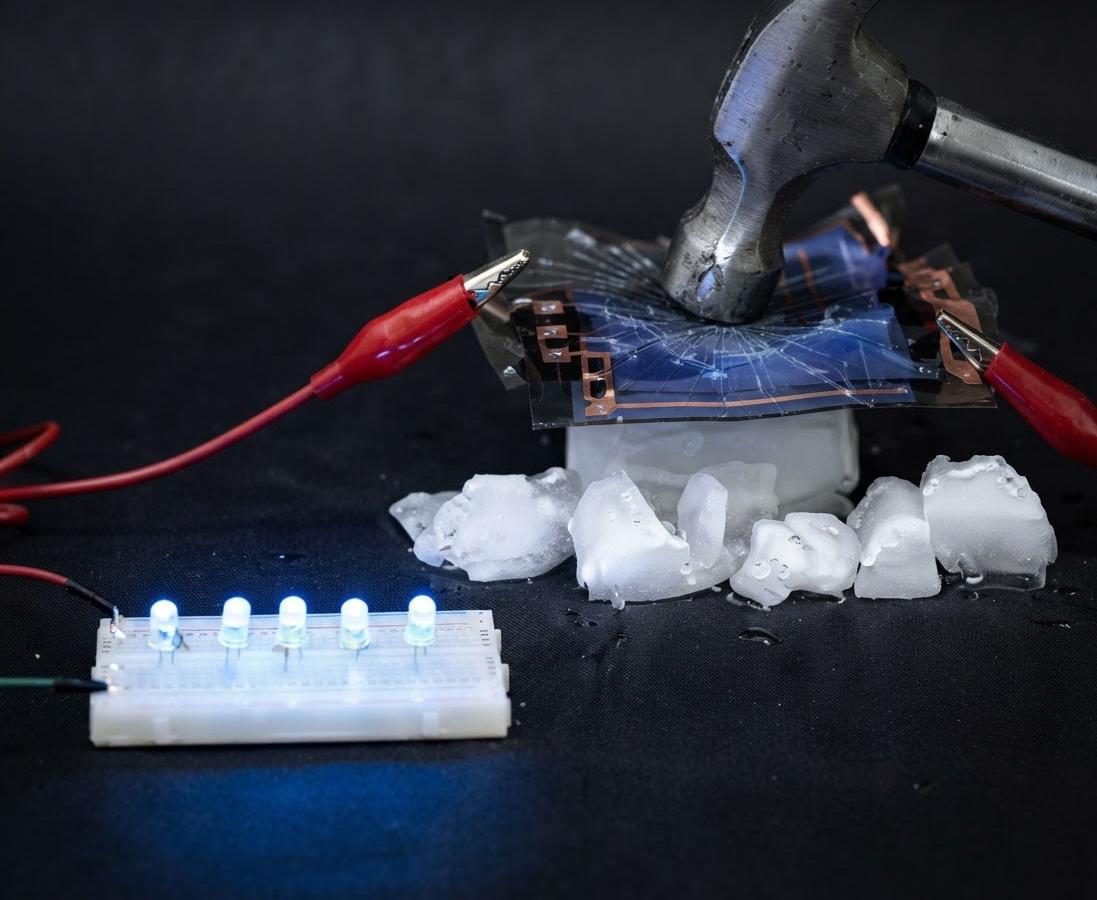
Researchers at POSTECH University in South Korea have developed a hydrogel-based electrolyte for flexible supercapacitors. The material maintains ion conductivity and flexibility at temperatures down to -20 degrees Celsius while absorbing mechanical impacts. The findings were published in the Chemical Engineering Journal.
The team, led by Professor Kim Yong-soo, created a structure combining hydrophilic and hydrophobic monomers with clay nanoparticles. This design features a robust polymer-clay frame for impact resistance and water-saturated channels for ion transport. The material is infused with a concentrated lithium chloride solution to prevent freezing.
Testing showed the hydrogel is 21 times more resistant to tearing than control samples, with ion conductivity increasing by 2.4 times. In impact tests, the material withstood repeated strikes from a steel hammer dropped from 15 cm at -20 degrees Celsius, while traditional hydrogel samples failed.
The supercapacitor remains functional when bent at 180 degrees at -20 degrees Celsius. After 5,000 charge-discharge cycles, it retained over 91.6 percent of its initial performance. Five connected units successfully powered an LED immediately following a hammer strike.