

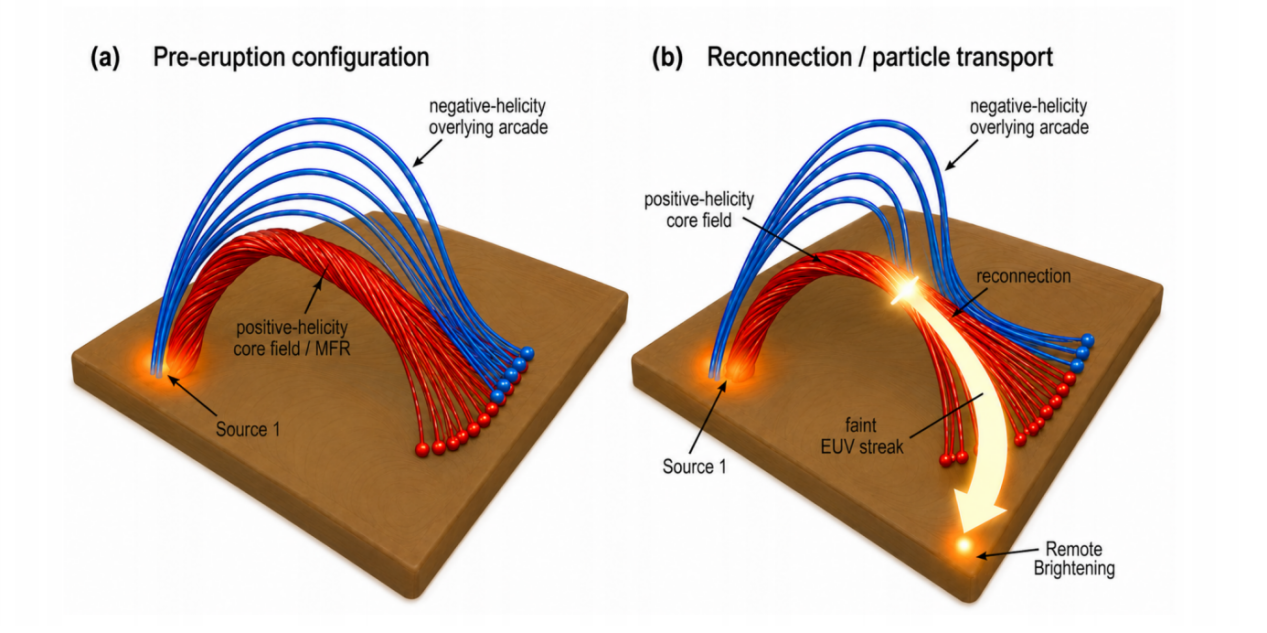
Researchers from the Yunnan Astronomical Observatory of the Chinese Academy of Sciences announced new findings regarding solar eruptions on September 26. The team obtained direct observational evidence of magnetic reconnection between two magnetic systems with opposite helicity signs during a medium-intensity solar flare.
The study, published in The Astrophysical Journal, utilized multi-band observation data from equipment including NVST, CHASE/HIS, SDO, and ASO-S. Scientists analyzed an M-class solar flare, identifying a low-level positive helicity core magnetic field and an overlying negative helicity magnetic arch.
The analysis revealed that the connectivity of magnetic field lines between these two systems changed during the eruption, accompanied by phenomena such as remote chromospheric brightening. This process likely weakens the overlying magnetic field constraints and promotes the instability of the erupting magnetic field.
The research team, led by master student Chang Jinrui and researcher Bi Yi, suggests that this anti-helicity magnetic reconnection plays a role in energy and particle transport. Future work will involve numerical simulations and additional flare events to test the universality of these findings.



