

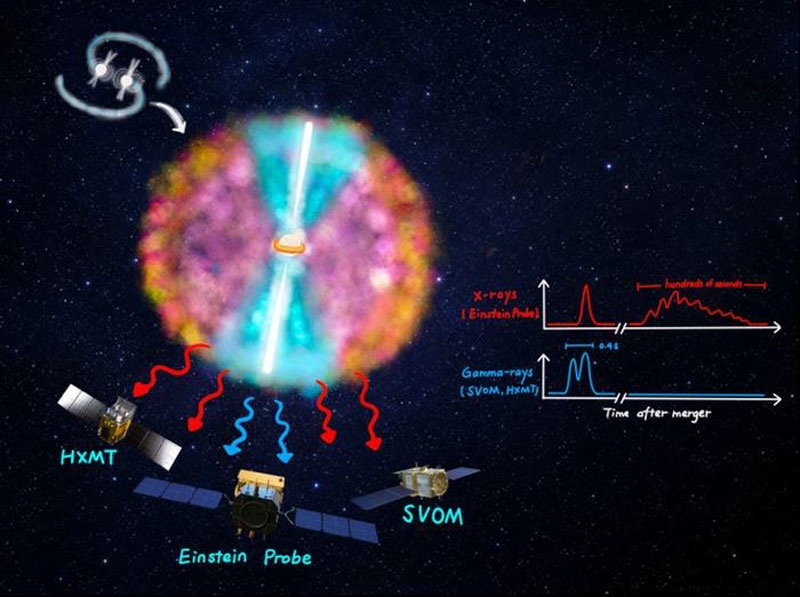
Astronomers have identified the source of mysterious X-ray bursts as the collision of two neutron stars. The discovery was made using the Einstein Probe, a joint European-Chinese X-ray telescope, which recorded the event designated as EP250704a/GRB 250704B.
Ground-based observatories, including the Very Large Telescope (VLT) in Chile, conducted follow-up observations shortly after the signal was detected. Using the X-shooter spectrograph, researchers identified iron and magnesium absorption lines, which indicated a redshift of z = 0.6610.
The data confirms the event occurred at a distance of over six billion light-years from Earth. The absence of supernova signatures, combined with the ten-minute duration of the X-ray emission, led scientists to conclude that the event was a neutron star merger.
Researchers hypothesize that the collision resulted in the formation of a magnetar, a neutron star with an intense magnetic field. This object likely powered the prolonged X-ray emission, challenging previous assumptions that such mergers only produce short gamma-ray bursts lasting under two seconds.


