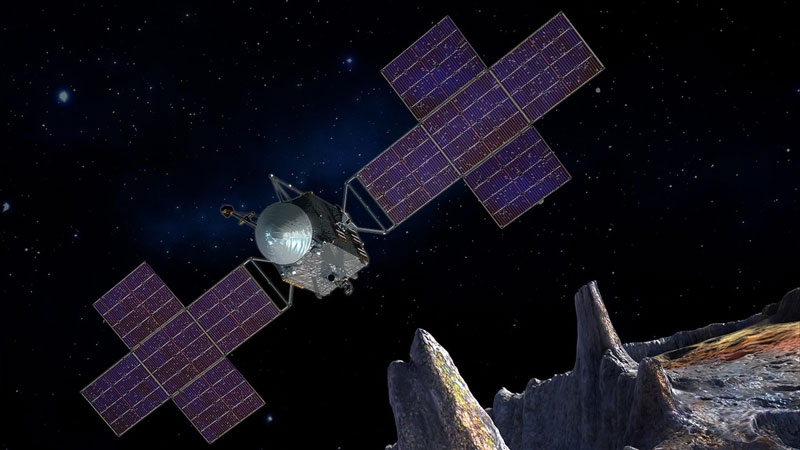
NASA has transitioned the Psyche spacecraft to near-continuous operation of its electric propulsion system. This adjustment aims to accelerate the probe's journey toward its namesake asteroid, located in the main belt between Mars and Jupiter, with arrival scheduled for the summer of 2029.
The spacecraft, which launched in October 2023, completed a gravity assist maneuver at Mars in May 2026. Since September 28, 2026, the four xenon-fueled Hall thrusters have been operating almost constantly, with brief weekly pauses for system checks and Earth communications.
The propulsion system utilizes solar panels covering approximately 75 square meters to generate power. While each thruster provides a maximum thrust of 250 millinewtons, the system is designed for long-duration operation. The probe is expected to reach a velocity of 44.4 kilometers per second relative to Earth.
At launch, the spacecraft carried approximately 1,090 kilograms of xenon across seven tanks, having consumed about one-third of this supply over the first three years. Engine power will be reduced by half over the coming months as the probe moves further from the Sun and solar energy production decreases.
The target asteroid, Psyche, measures approximately 280 kilometers in diameter and is believed to be the metal-rich core of a protoplanet. Researchers estimate the value of the metals within the asteroid at $10 quintillion, a figure cited during the project's initial funding phase.