

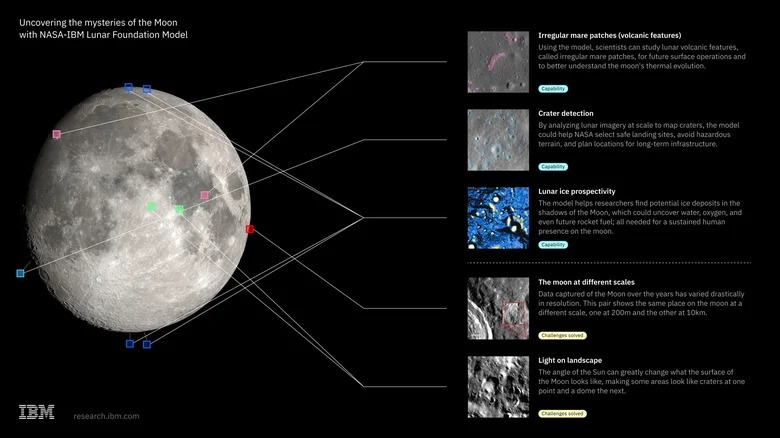
NASA and IBM have jointly released an open-source AI foundation model for lunar research, now available on the Hugging Face platform. The system is designed to assist researchers in analyzing lunar surface data, specifically focusing on identifying potential ice deposits and mapping craters.
In comparative tests against Microsoft's SwinV2-B model, the NASA-IBM system demonstrated a 23% reduction in identification errors. Furthermore, when classifying craters, the new model outperformed the benchmark by 19% while utilizing only half the training data.
The model successfully identified a new crater created by a SpaceX Falcon 9 rocket impact on August 5. IBM researchers noted that the AI accurately detected the impact site even when it overlapped with existing geological features, despite the challenges posed by the moon's harsh lighting conditions.
Training the model required a novel approach due to the unique nature of lunar imagery, where sharp shadows often obscure data. Researchers abandoned traditional image-masking techniques in favor of a sector-based training method to ensure consistency across different lunar surface segments.
The release includes a comprehensive open-source dataset, the first of its kind, featuring over 2 million data points. This collection integrates information from NASA's Lunar Reconnaissance Orbiter and GRAIL missions, as well as Japan's SELENE probe, providing a standardized grid for future research.



