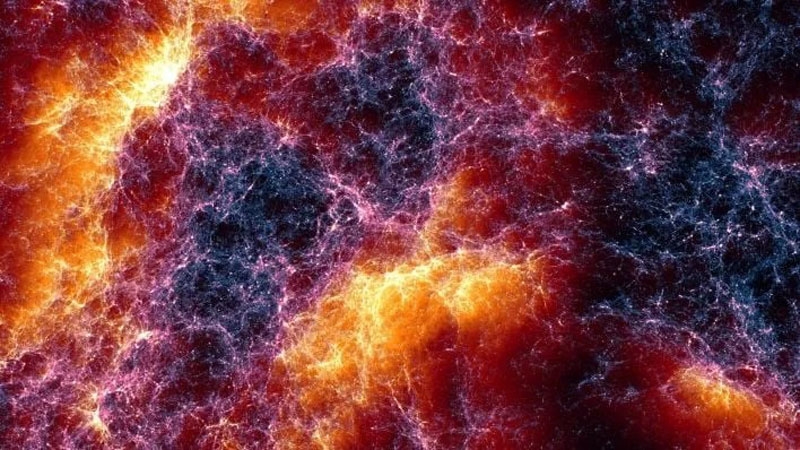
Researchers from MIT and partner institutions have unveiled Lumina, a large-scale simulation of the universe covering its first two billion years. The project models the formation of early stars and galaxies, as well as the state of intergalactic gas, by building upon the IllustrisTNG software suite with added radiation transport modeling.
The simulation was executed on the Frontier supercomputer at the Oak Ridge National Laboratory in the United States. At peak performance, the project utilized over 100,000 CPU cores and approximately 15,000 GPUs. The model encompasses a cubic volume with a side length of 1.63 billion light-years, containing 432 billion elements representing dark matter and gas.
Lumina focuses on the reionization of hydrogen by young stars and the subsequent ionization of helium driven by supermassive black holes. The researchers claim the simulated volume is roughly 100 times larger than previous models used for similar studies. The data will be made publicly available to the scientific community starting in 2028.
The model aims to provide a framework for interpreting observations from the James Webb Space Telescope and the future Roman Space Telescope. While not a direct reconstruction of the past, Lumina calculates the probable evolution of cosmic structures based on physical laws and initial conditions, allowing for the simultaneous study of large-scale structures and individual galaxies.