

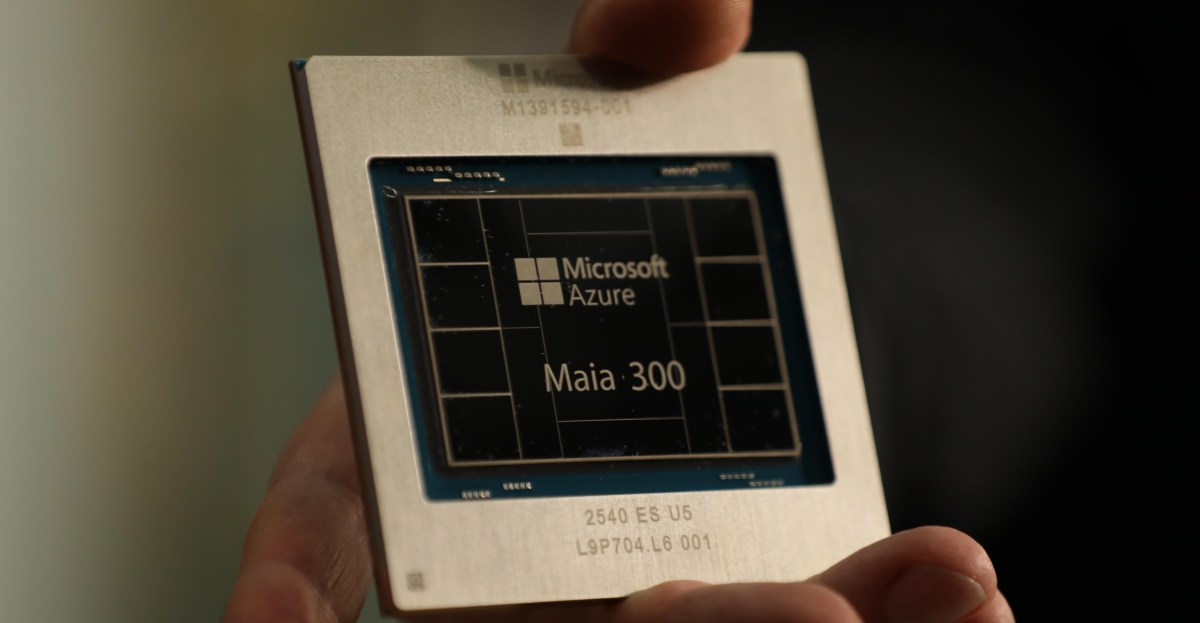
Microsoft has unveiled its third-generation Maia 300 AI chip, which is set to become the primary inference system for the company's products and services. The new hardware is designed to handle advanced reasoning models and agentic tasks, with production rollout scheduled for 2027.
The chip utilizes a chiplet architecture built on the TSMC N2P process node. This design separates compute, memory controller, and I/O functions to maximize silicon area for performance. According to executive vice president Scott Guthrie, the system is expected to deliver 40 percent more tokens per megawatt than current GPU-based alternatives.
In a 96-accelerator configuration, the Maia 300 offers up to 7 times the rack-scale token throughput of the previous Maia 200 model. Microsoft plans to scale the Azure Maia family to multi-gigawatt deployments by 2027, aiming to reduce its reliance on external GPU suppliers like Nvidia and AMD.
The Maia 200, announced in January, currently supports production workloads including Microsoft Copilot, GitHub Copilot, and Microsoft Foundry. The new Maia 300 is specifically optimized for long-context reasoning, latency-sensitive conversational experiences, and multi-step agentic tasks.



