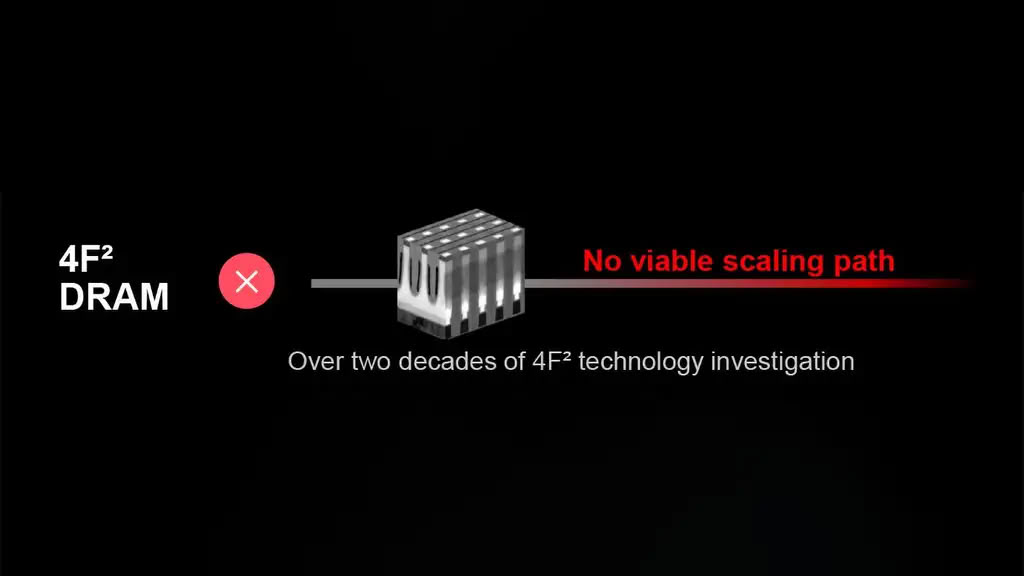
Micron has officially abandoned its 4F² DRAM project after two decades of internal research. Scott DeBoer, the company's President and Chief Technology and Products Officer, announced the decision during a technology webinar held on October 21. Despite the design's potential to reduce memory cell footprints by approximately one-third compared to the current 6F² standard, the company concluded that the density benefits are overstated due to capacitor packing limitations.
The company stated that 4F² technology involves higher manufacturing complexity and costs, while facing scaling issues at advanced nodes. Consequently, Micron plans to continue scaling its existing 6F² architecture. The 1-delta node is scheduled to begin production in Boise, Idaho, during the second half of 2027, followed by the 1-epsilon node, which will utilize wafer bonding technology.
Micron is pursuing 3D DRAM as an alternative development path, though it has not provided a specific timeline for commercialization, citing a need for favorable economic conditions. This strategy contrasts with competitors like Samsung and SK hynix, which continue to develop 4F² designs. Additionally, Chinese manufacturer CXMT expects to release its first 4F² server DDR5 RDIMM product by the end of this year.
The decision represents a strategic shift as Micron anticipates tighter memory supply conditions throughout 2027 and 2028. While the company focuses on its current roadmap, it acknowledges the potential risk if competitors successfully achieve cost-effective, large-scale production of 4F² memory.