

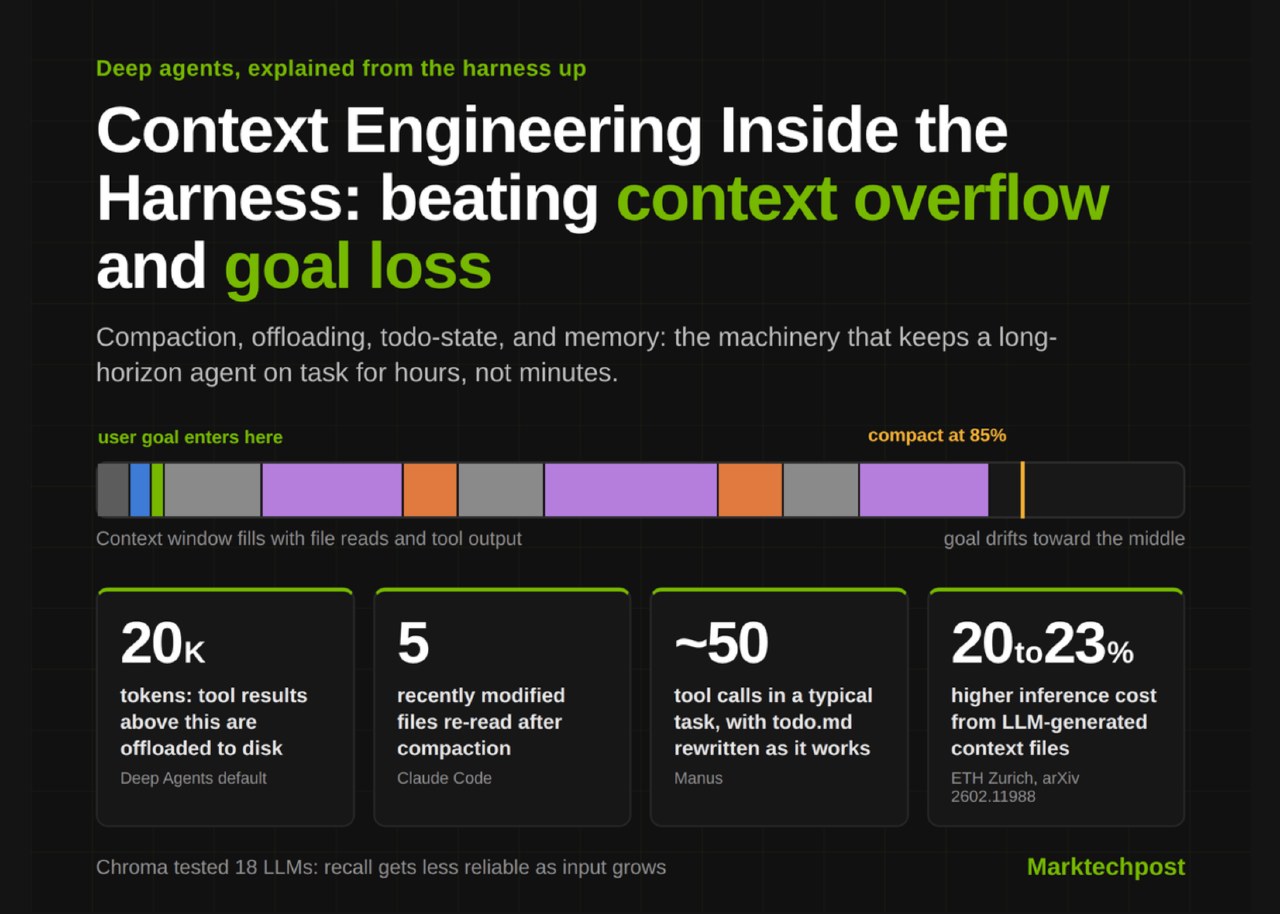
Developers are increasingly using context engineering to prevent goal loss in long-horizon AI tasks. Research indicates that simply expanding context windows is insufficient, as performance degrades with input length. Instead, tools like LangChain Deep Agents, Claude Code, Manus, and Amazon Bedrock AgentCore employ four core mechanisms to manage information effectively.
Offloading is the first defense, where agents move large data to the filesystem. Deep Agents offloads tool responses exceeding 20,000 tokens to disk, while Claude Code caps auto memory at 200 lines or 25KB. These systems prioritize path references over raw content to keep the attention budget focused on active task requirements.
Compaction serves as a secondary strategy, summarizing conversation history when limits are reached. Claude Code preserves architectural decisions and recent file modifications during this process. OpenAI has integrated server-side compaction into its API, allowing developers to manage context windows via specific thresholds and endpoints to sustain long-running coding tasks.
Todo-state management ensures goal persistence by rewriting objectives into the context window. Manus uses a todo.md file to keep plans in the model's recent attention span. While LangChain found that todo lists can sometimes increase costs, they remain recommended for complex, multi-step tasks where maintaining the original intent is critical.
Finally, persistent memory allows agents to recall information across sessions. AWS AgentCore and Claude Code use file-based storage to reload project-specific rules. However, studies from ETH Zurich suggest that excessive persistent context, such as large repository files, can increase inference costs by up to 23% without guaranteed improvements in task success.



