

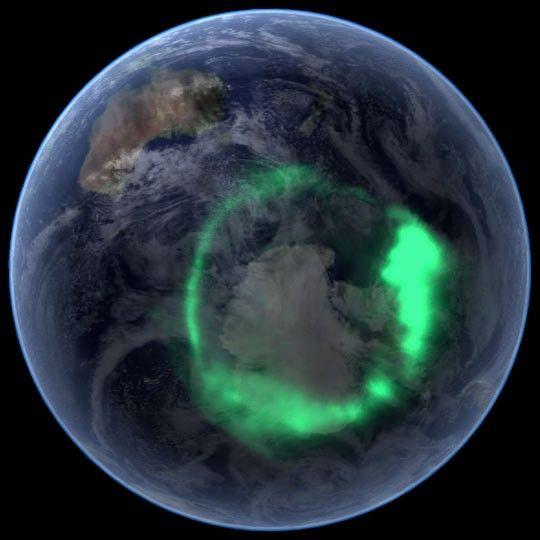
Researchers from Kyoto University have proposed a new mechanism for the origin of early organic molecules on Earth. The study suggests that the planet's ancient magnetic field concentrated charged particles in polar regions, creating localized zones for chemical reactions.
Unlike ultraviolet radiation or lightning, which affect the planet uniformly, the magnetic field directed cosmic particles to specific high-latitude areas. This constant energy flow could have supported non-equilibrium reactions necessary for the development of complex chemical systems.
Previous experiments have demonstrated that energetic particles can form amino acids and carboxylic acids under conditions simulating the early Earth. The researchers suggest that an atmosphere containing nitrogen, carbon dioxide, and water vapor facilitated the creation of reactive compounds.
The hypothesis also incorporates cycles of freezing and thawing, which may have concentrated these molecules to promote further chemical evolution. This suggests that prebiotic chemistry occurred in geographically restricted areas rather than across the entire planet.
The team notes that this model allows for testable predictions compared to existing theories. Furthermore, the researchers propose applying this principle to evaluate the potential for life on exoplanets that possess their own magnetic fields.



