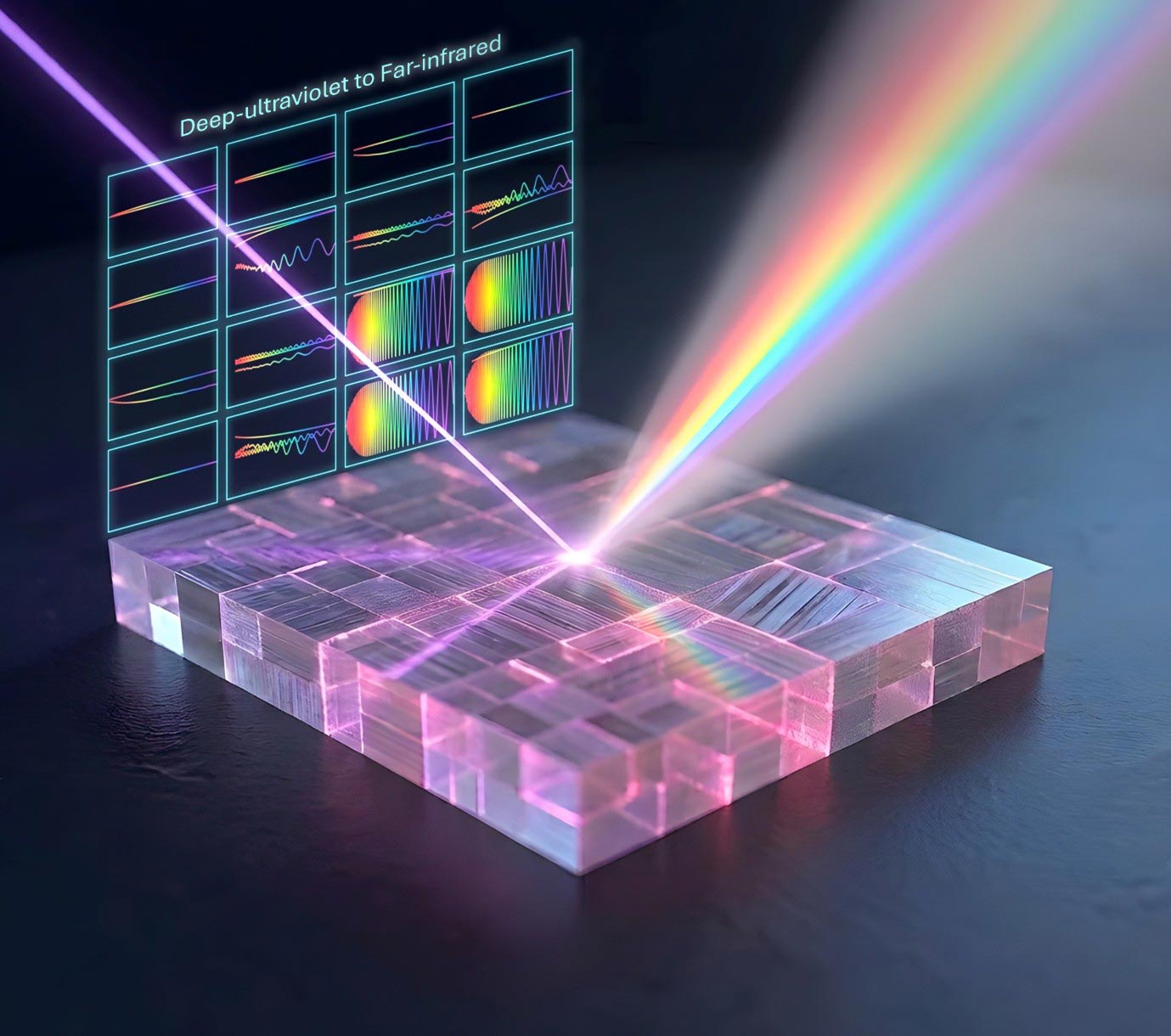
A research team from KAIST, led by Professor Jang Min Seok, has determined the intrinsic optical properties of barium titanate (BaTiO3) across a broad spectral range. The study, conducted in collaboration with Caltech, the Korea Research Institute of Standards and Science, and J.A. Woollam, was published in the journal ACS Photonics on October 20, 2026.
Barium titanate is a crystal known for the Pockels effect, which allows it to change its refractive index under an external electric field. This property makes it a candidate for high-speed optical modulators, which convert electrical signals into optical signals for data transmission. Previously, inconsistent measurements of its refractive index and absorption hindered device design.
Researchers used Mueller-matrix spectroscopic ellipsometry on a-cut and c-cut single-crystal samples to minimize interference from crystal domains. The measurements spanned from 190 nanometers to 40 micrometers. The team also developed a mathematical model to predict the optical response of crystals containing multiple domain orientations.
The study successfully measured the extinction coefficient of barium titanate in the 2 to 10 micrometer range, achieving sensitivity as low as 10⁻⁵. This data on light absorption is critical for designing efficient optical waveguides and photonic chips, as it helps engineers predict signal loss during transmission.
These findings provide a foundation for developing high-speed optical modulators, quantum information processing devices, and photonic integrated circuits. While the research does not involve the immediate production of new internet hardware, it eliminates long-standing uncertainties in material parameters to accelerate future device development.