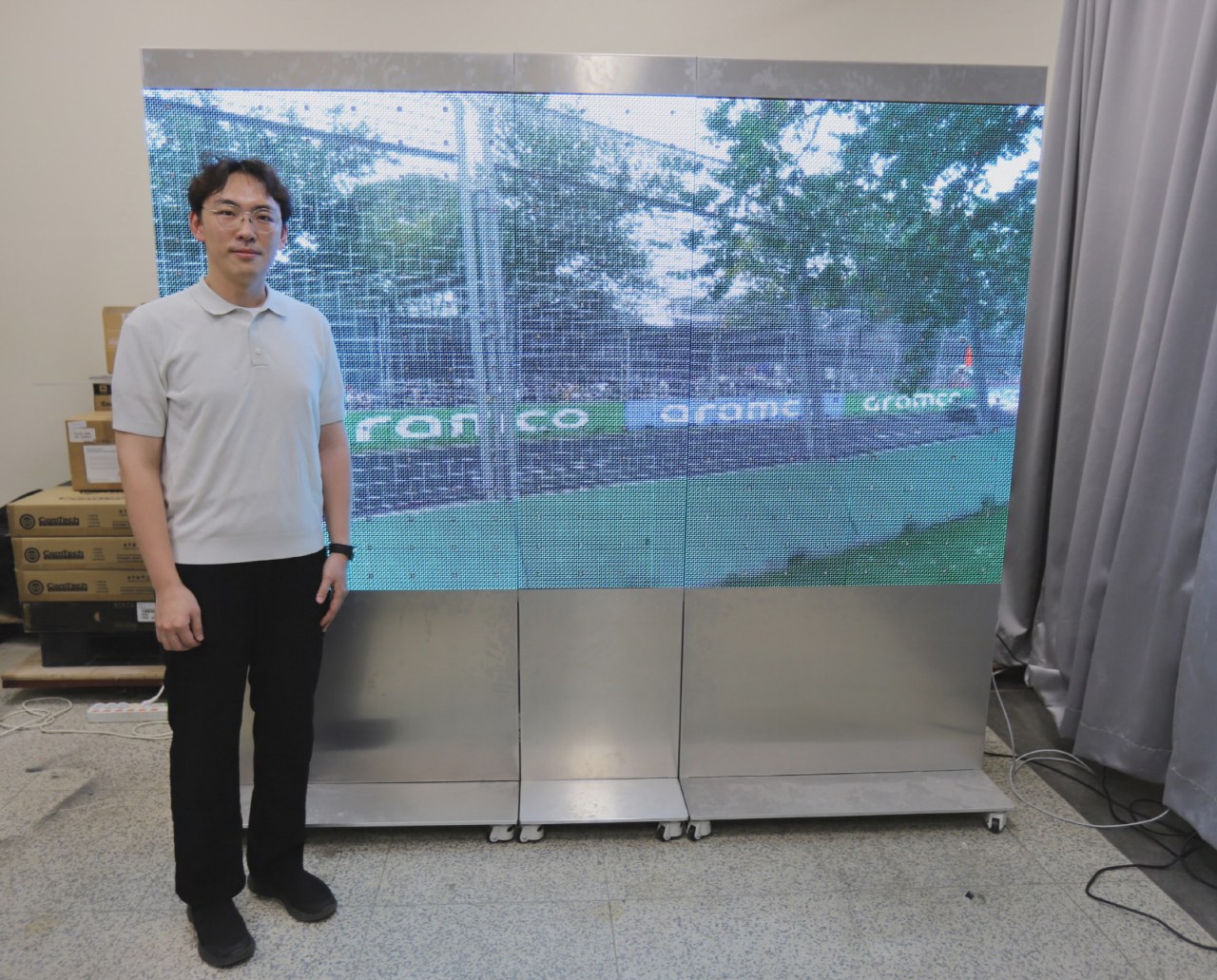
Researchers at the Korea Institute of Machinery and Materials (KIMM) have developed a modular display technology that allows sound to originate directly from specific points on a screen. The system uses a grid of 80 voice coil motors (VCMs) mounted behind a 100-inch prototype consisting of transparent LED film and aluminum panels.
To achieve precise sound localization, the team uses the Moore-Penrose pseudoinverse algorithm to calculate the necessary voltage for each motor, creating localized vibration fields. An AI-based system automatically identifies sound sources in video content and tracks their movement across the screen in real time.
Testing indicates the system achieves 99.9% accuracy in selecting target sound areas, with a vibration amplitude difference of up to 35 decibels between active and inactive zones. The technology currently performs best in low and mid-frequency ranges below 500 Hz.
The modular design allows the technology to be scaled for various applications, ranging from home televisions to large-scale commercial LED walls and digital signage. While the system improves spatial alignment, researchers note it does not yet fully replace professional audio systems in terms of sound pressure and full-frequency coverage.