

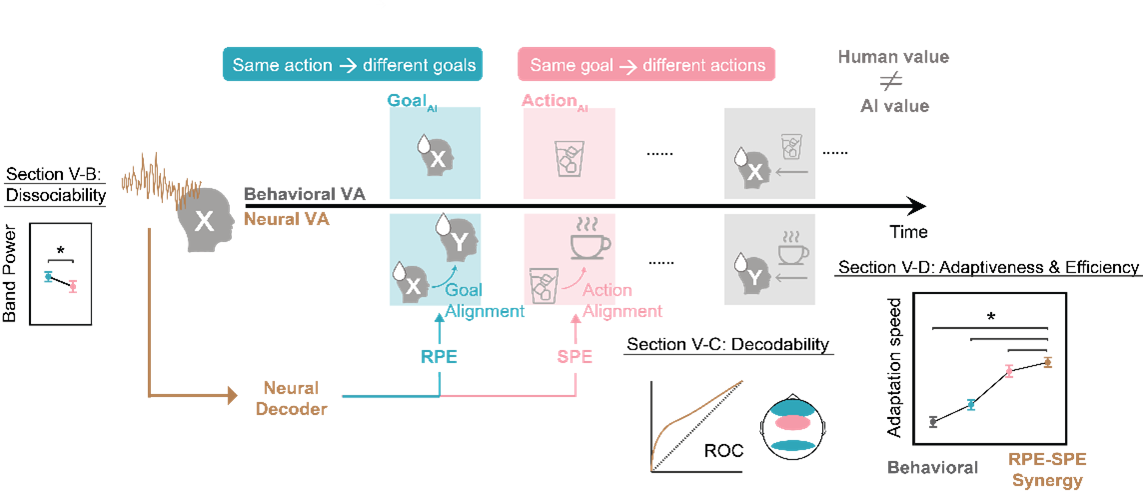
The Korea Advanced Institute of Science and Technology (KAIST) and Microsoft Research Asia have developed a brain-computer interface technology called Neural Value Alignment (NVA). The system monitors human brainwaves using electroencephalography (EEG) to detect if an artificial intelligence has misinterpreted a user's intent during task execution.
The NVA system identifies specific neural signals, known as prediction error signals, that occur when AI actions deviate from user expectations. By analyzing these signals, the system provides feedback to the AI, allowing it to recognize and correct its behavior without requiring additional verbal instructions from the user.
The research focuses on two types of neural signals: reward prediction errors, which indicate whether an outcome aligns with personal goals, and state prediction errors, which track whether the process matches the user's mental model. This dual approach helps the AI determine if the error lies in the goal or the execution method.
Experimental results demonstrate that integrating EEG feedback enables AI to infer user intent more accurately and adjust its actions in real time. The team suggests this technology could be applied to robotics, human-machine collaboration systems, and intelligent assistants to create more efficient and intuitive interactions.

