

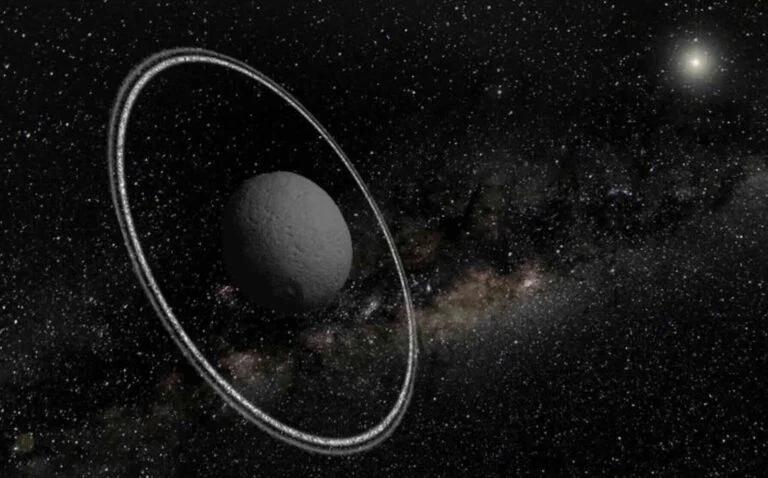
The James Webb Space Telescope has successfully observed a stellar occultation by the minor body 10199 Chariklo, a centaur orbiting between Jupiter and Neptune. This marks the first time such a planned observation has been conducted for a small solar system object.
Researchers from the Institute of Astrophysics of Andalusia compared data from October 2022 with observations spanning the last decade. They discovered that the two rings of Chariklo are changing in opposite ways: the inner ring has become significantly denser, while the outer ring has decreased in density.
The study required extreme precision, involving the orbital data of Chariklo, stellar positioning from the Gaia mission, and the exact trajectory of the telescope. The JWST is positioned approximately 1.5 million kilometers from Earth at the L2 Lagrange point and requires periodic station-keeping maneuvers.
Chariklo is the second-largest object known to possess rings, following the centaur Chiron. The observed dynamic behavior suggests that ring systems are influenced by a wider range of processes than previously assumed, prompting scientists to re-evaluate current models of ring formation and stability.



