

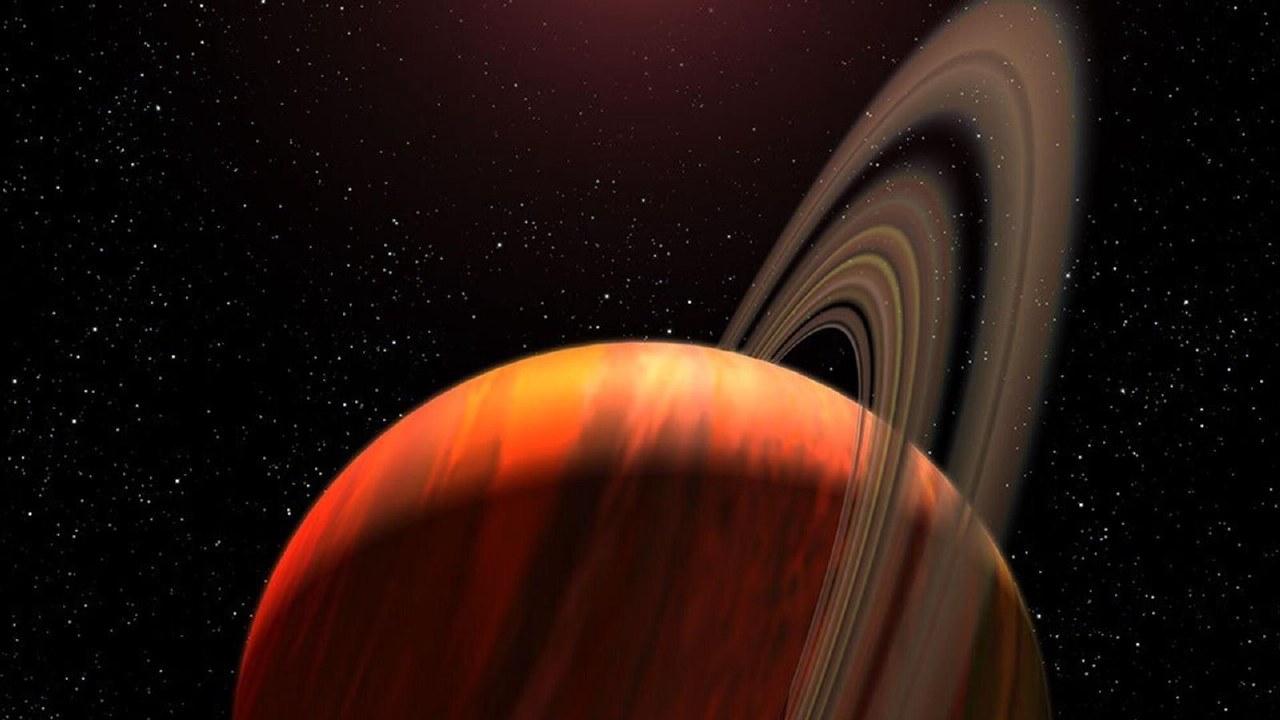
The James Webb Space Telescope has analyzed the atmosphere of the giant exoplanet HATS-6 b, located 500 light-years from Earth. The planet orbits a small M-class red dwarf, completing a full revolution in three days. Researchers identified water, methane, carbon dioxide, and ammonia in its atmosphere using transmission spectroscopy.
The detection of ammonia is significant, as it marks only the second time this compound has been identified on an exoplanet using this method. HATS-6 b is one of seven planets being studied under the GEMS program, which focuses on gas giants orbiting red dwarfs. Astronomers note that such systems are rare, with only about 40 known examples.
Data from the telescope suggests a temperature of approximately 120 degrees Celsius, which is significantly lower than the previously estimated equilibrium temperature of 425 degrees Celsius. Scientists hypothesize that dense clouds or haze, similar to those found on Venus, may be reflecting radiation back into space.
The discrepancy between calculated and observed temperatures is critical for future atmospheric analysis. Researchers plan to conduct further observations on longer wavelengths to verify the cloud hypothesis, refine the temperature data, and gain a better understanding of the chemical composition of this unique planetary system.



