

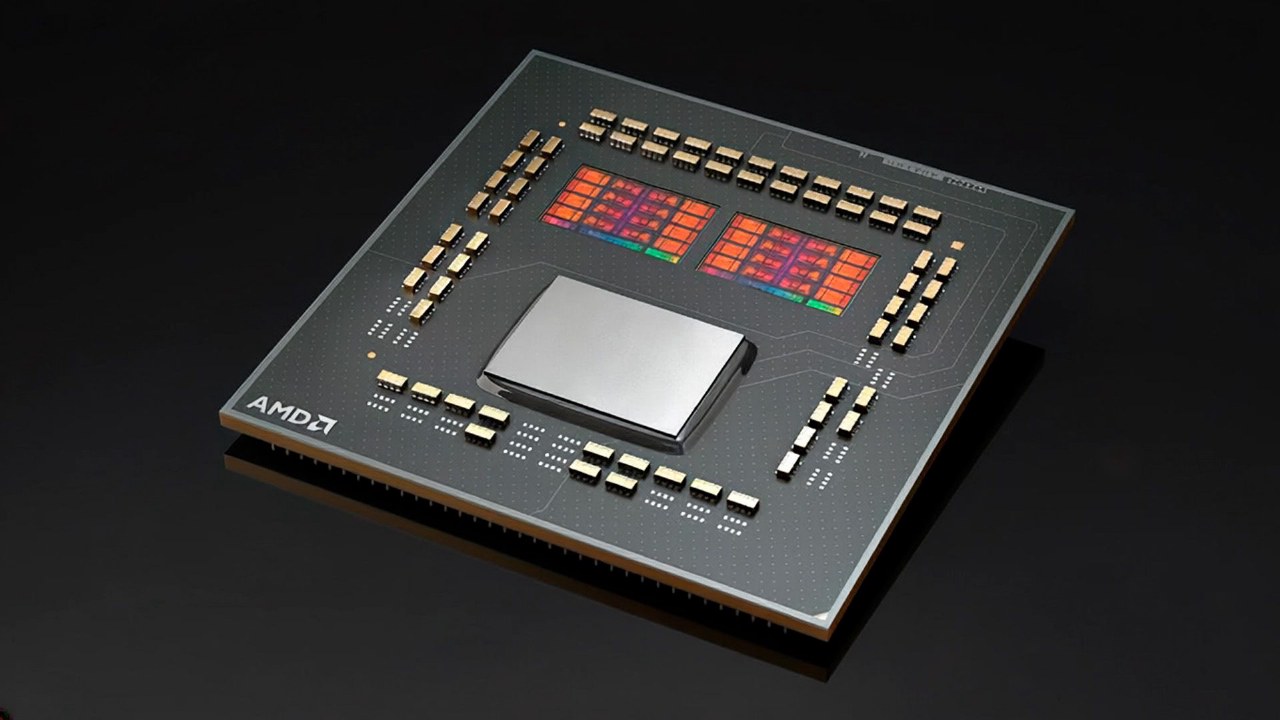
AMD previously showcased a 12-core 3D chiplet prototype at Computex 2021. This engineering sample, identified as 100-000000652-20_48/32_Y, featured 128MB of L3 cache, which is double the capacity of the standard Ryzen 9 5900X.
The prototype achieved a boost clock speed of approximately 4.7 GHz, only 100 MHz lower than the retail Ryzen 9 5900X. During testing, the chip demonstrated up to 15% higher average gaming performance than the standard model at a fixed 4 GHz frequency.
Internal experiments by AMD also included 12-core and 16-core Zen 3 processors equipped with 192MB of L3 cache. These configurations involved integrating 64MB of 3D V-Cache onto both Core Complex Dies (CCDs) within the chip.
AMD ultimately opted for an asymmetric design for its retail gaming processors, prioritizing the eight-core Ryzen 7 5800X3D. This approach avoids cross-die latency issues associated with stacking 3D V-Cache on both CCDs in multi-core configurations.
While the company initially bypassed 12-core and 16-core Zen 3 models for the 3D V-Cache rollout, it later introduced dual-stack designs in the Zen 4 and Zen 5 generations, including the Ryzen 9 7900X3D, 7950X3D, 9900X3D, and 9950X3D.


