

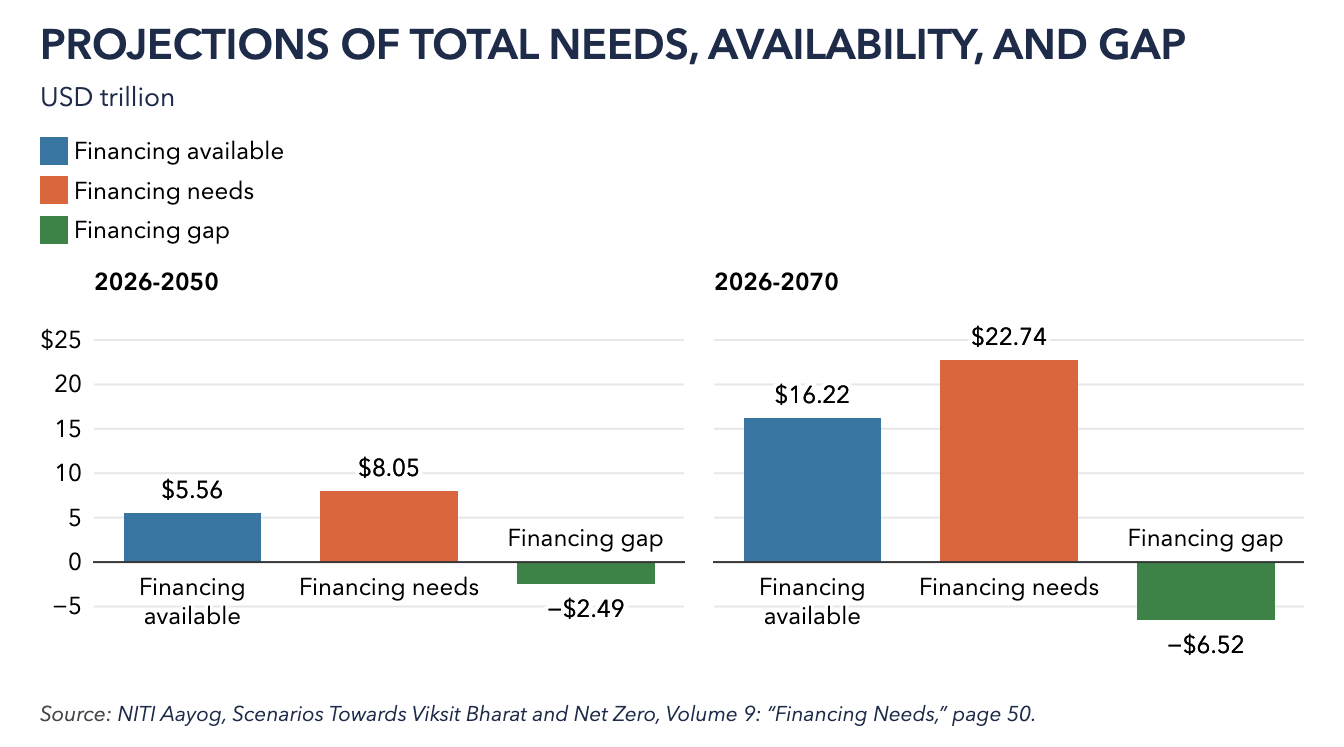
India is advocating for a shift in international climate finance as it hosts the BRICS summit in New Delhi on September 12–13, 2026. The country aims to address a projected financing gap of $100 billion annually over the next two decades to meet its net-zero goals by 2070.
According to a NITI Aayog report, India faces a total financing requirement of $8.05 trillion by 2050, with $5.56 trillion currently available. Domestically, India already covers 83 percent of its mitigation finance and 98 percent of its adaptation finance requirements.
India has achieved a milestone with non-fossil fuel sources now accounting for over 54 percent of its installed power capacity. Renewable energy sources recently met more than half of the national electricity demand, positioning the transition as a core energy security imperative.
The country is pushing for global adaptation finance, which remains significantly underfunded compared to mitigation efforts. Global adaptation funding reached $64 billion in 2024, while the Adaptation Fund has failed to meet its $300 million annual target for three years.
At the BRICS summit, member nations agreed to enhance cooperation on climate adaptation. India intends to leverage its presidency to integrate resilience into formal climate finance frameworks, emphasizing the need to make such investments scalable and accessible.

