

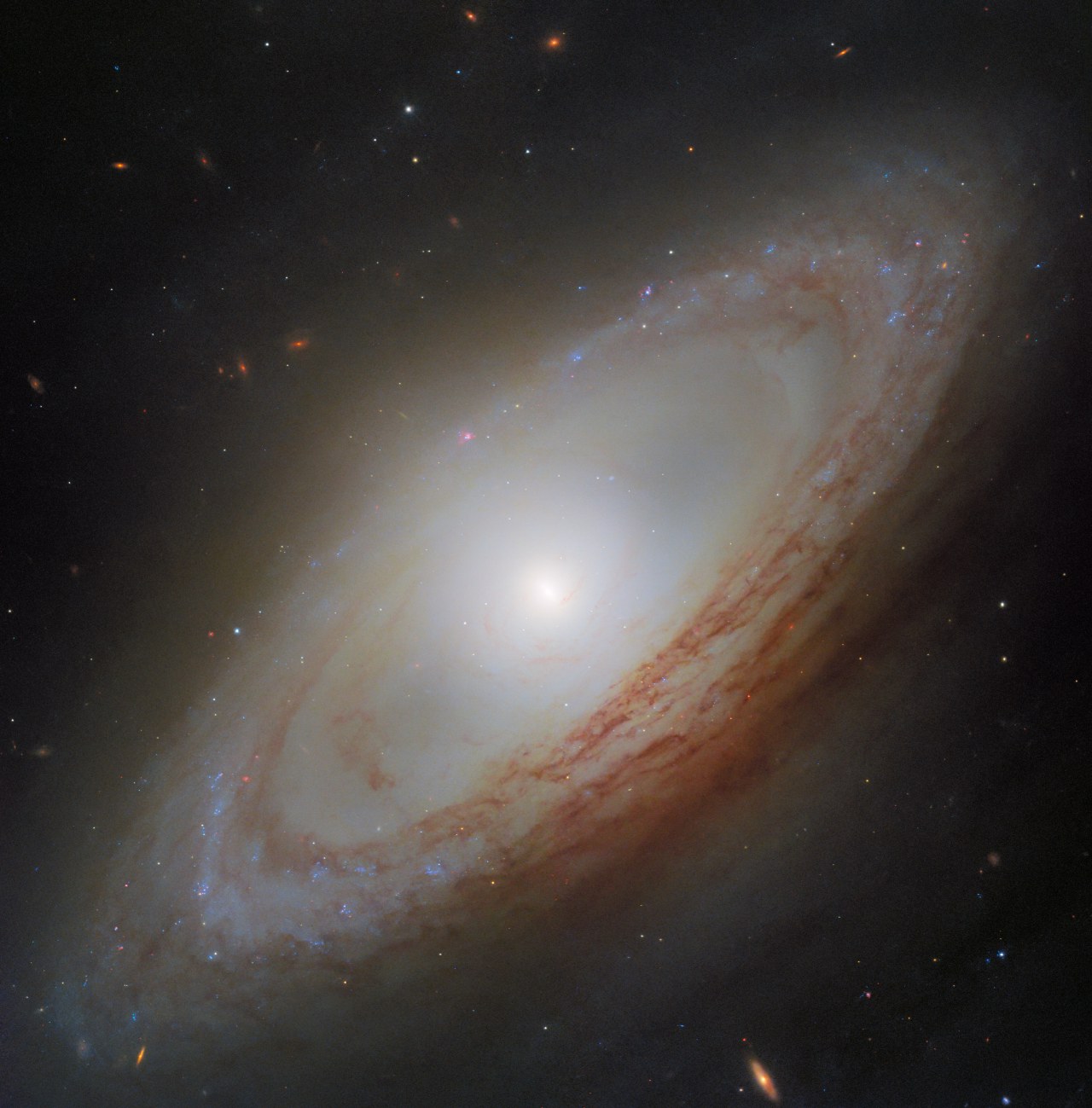
The NASA/ESA Hubble Space Telescope has captured imagery of the spiral galaxy NGC 4698, located approximately 55 million light-years away in the Virgo Cluster. This structure is part of a cluster containing over a thousand gravitationally bound galaxies. While it shares characteristics with the Milky Way, such as a thin disk of stars, gas, and dust, its internal dynamics differ significantly from typical spiral galaxies.
The galaxy features an elongated central bulge containing older, cooler stars orbiting a supermassive black hole. Observations indicate this black hole is actively accumulating gas. Unlike most spiral galaxies where arms extend to the center, the arms of NGC 4698 are primarily located in the outer disk, forming a ring-like structure around the perimeter.
A distinct feature of NGC 4698 is its central bulge, which extends at a right angle to the disk. Furthermore, the gas and stars near the core rotate perpendicularly to the main disk. Astronomers suggest this unusual orientation may result from a past minor galactic merger, supported by the presence of a hydrogen tail extending from the galaxy.
The image was produced as part of a research program analyzing galaxies within the Virgo Cluster. Scientists are utilizing these data to examine individual star clusters and nebulae, as well as to study how the movement of a galaxy through a cluster influences its evolution and star formation capabilities.



