

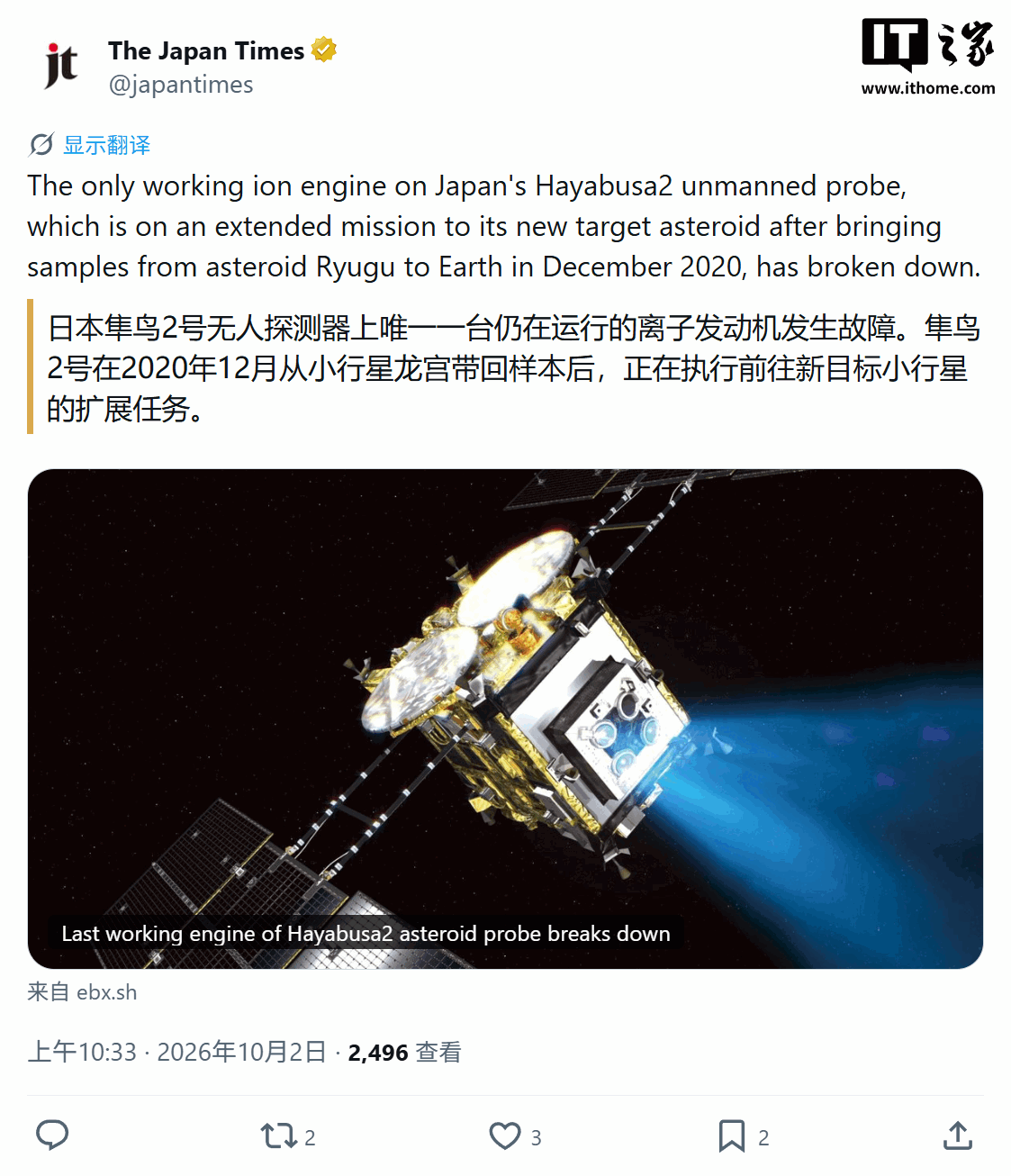
The Hayabusa2 asteroid probe, operated by the Japan Aerospace Exploration Agency (JAXA), has encountered a critical failure in its final operational ion engine. Launched in December 2014, the spacecraft successfully returned samples from the asteroid Ryugu to Earth in December 2020. Following this mission, the probe was redirected toward a new target, the asteroid 1998 KY26.
The probe was originally equipped with four ion engines. Engines A, C, and D had previously experienced significant performance degradation, leaving engine B as the primary propulsion source for the extended mission. However, engine B suffered a failure in mid-August. Although JAXA attempted to repair the unit, the ion source remains non-functional, while the neutralizer continues to operate.
Engineers are now exploring a workaround by attempting to combine the functional neutralizer from engine B with the working ion source of engine D. This involves complex circuit switching. The probe has been in operation for nearly 12 years, far exceeding its initial design lifespan, which complicates the mission's future.
JAXA has not yet confirmed whether the spacecraft will successfully reach the asteroid 1998 KY26 by 2031. The feasibility of the mission depends heavily on the overall level of hardware degradation across the aging probe. The agency continues to monitor the situation as it attempts to stabilize the propulsion system.



