

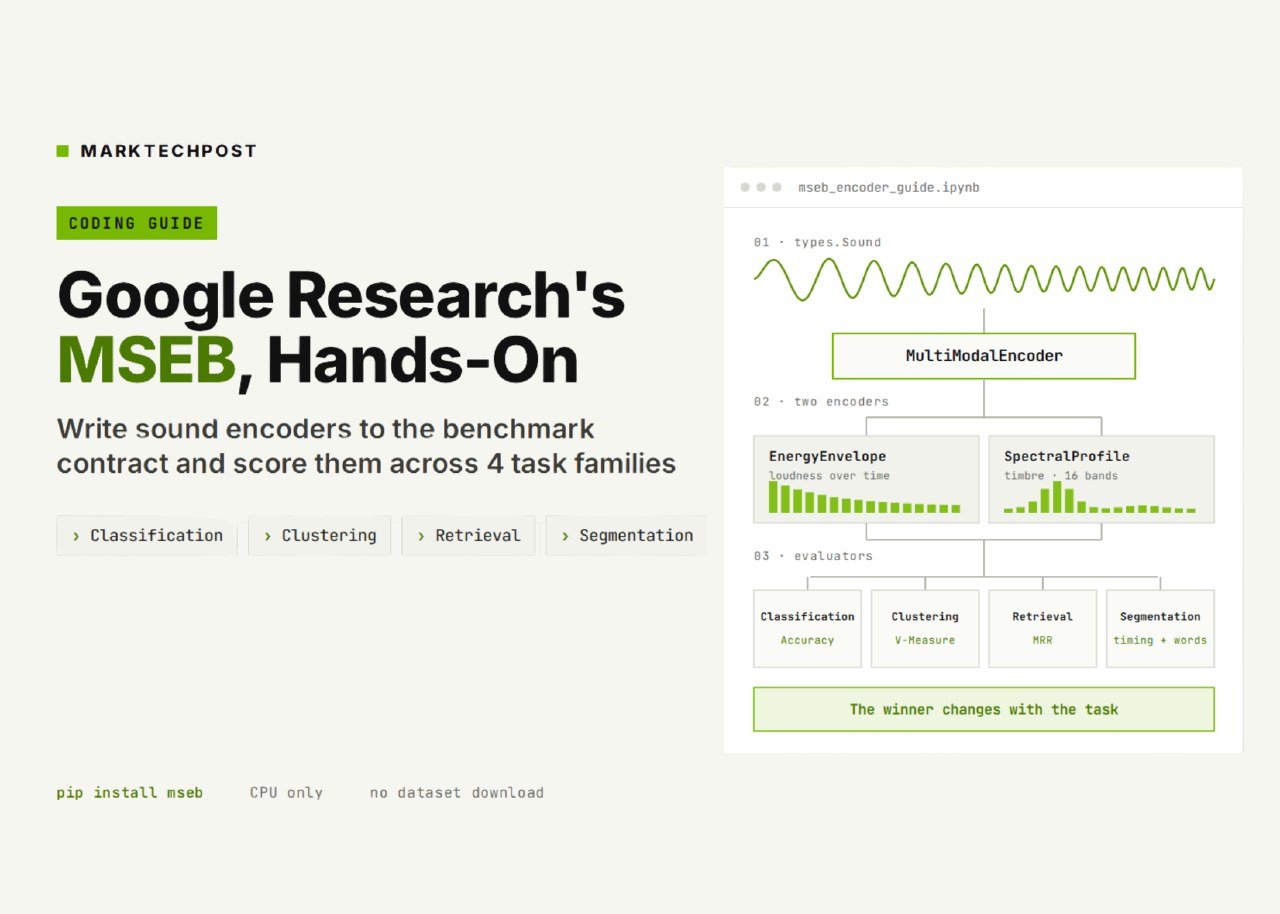
Google Research has released the MSEB benchmark, a framework designed for evaluating audio models. The system consists of three primary layers: types, which define the data structure for audio and embeddings; encoder, which provides the interface for model implementation; and evaluators, which handle specific task families like classification and segmentation.
Developers implement models by subclassing the MultiModalEncoder, which requires defining three methods: _setup for initialization, _check_input_types for validation, and _encode for processing audio batches. The framework automatically attaches EncodingStats to results, providing metrics such as compression ratios and FLOP counts without manual input.
The benchmark supports various evaluation tasks, including classification, clustering, retrieval, and segmentation. While lightweight tasks rely on NumPy and scikit-learn, more complex operations like transcription or reranking integrate external libraries such as Whisper, TensorFlow, and Apache Beam. The framework allows for synthetic audio generation to enable testing on CPU runtimes.
The MSEB type system enforces strict data contracts. A Sound object carries waveform data and context, while a SoundEmbedding stores vector arrays and timestamps. A Score object validates metrics like accuracy, ensuring that only correctly formatted results are accepted. This structure prevents malformed data from reaching the leaderboard.



