

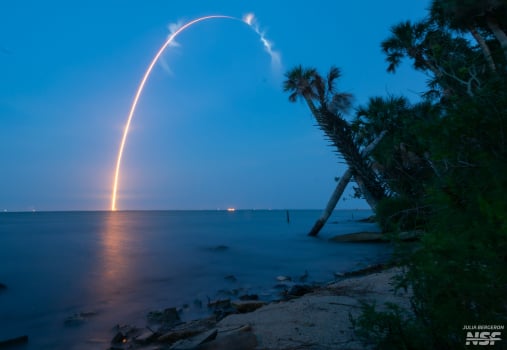
The week features nine orbital launches globally. On September 15, a Vega C rocket launched from French Guiana, carrying the Sentinel-3C satellite and the FLEX payload into Sun-synchronous orbit. Simultaneously, China conducted a ZhuQue-2E launch from the Jiuquan Satellite Launch Center, delivering ten communications satellites for the SpaceSail Polar Group.
Also on September 15, the Gravity 1 vehicle by Orienspace launched from the Haiyang Oriental Spaceport, marking its fourth flight overall. In the United States, SpaceX scheduled a Falcon 9 mission from Vandenberg Space Force Base to deploy the classified USSF-25 payload. This flight utilizes the B1097 booster on its 13th mission, contributing to the 720th SpaceX launch.
On September 16, a Russian Soyuz 2.1b is set to launch the Progress MS-35 cargo vehicle from the Baikonur Cosmodrome to the International Space Station. This mission represents the sixth flight of the Soyuz 2.1b in 2026. Further Chinese launches include the Chang Zheng 12 on September 17 and the Kuaizhou 11, which will deliver an unspecified payload to low-Earth orbit.
The launch schedule concludes with a Chang Zheng 2D mission from the Taiyuan Satellite Launch Center on September 19. On the same day, SpaceX plans to launch 27 Starlink v2 Mini satellites using the B1093 booster on its 17th flight. These missions contribute to a total of 225 orbital launch attempts recorded worldwide throughout 2026.


