

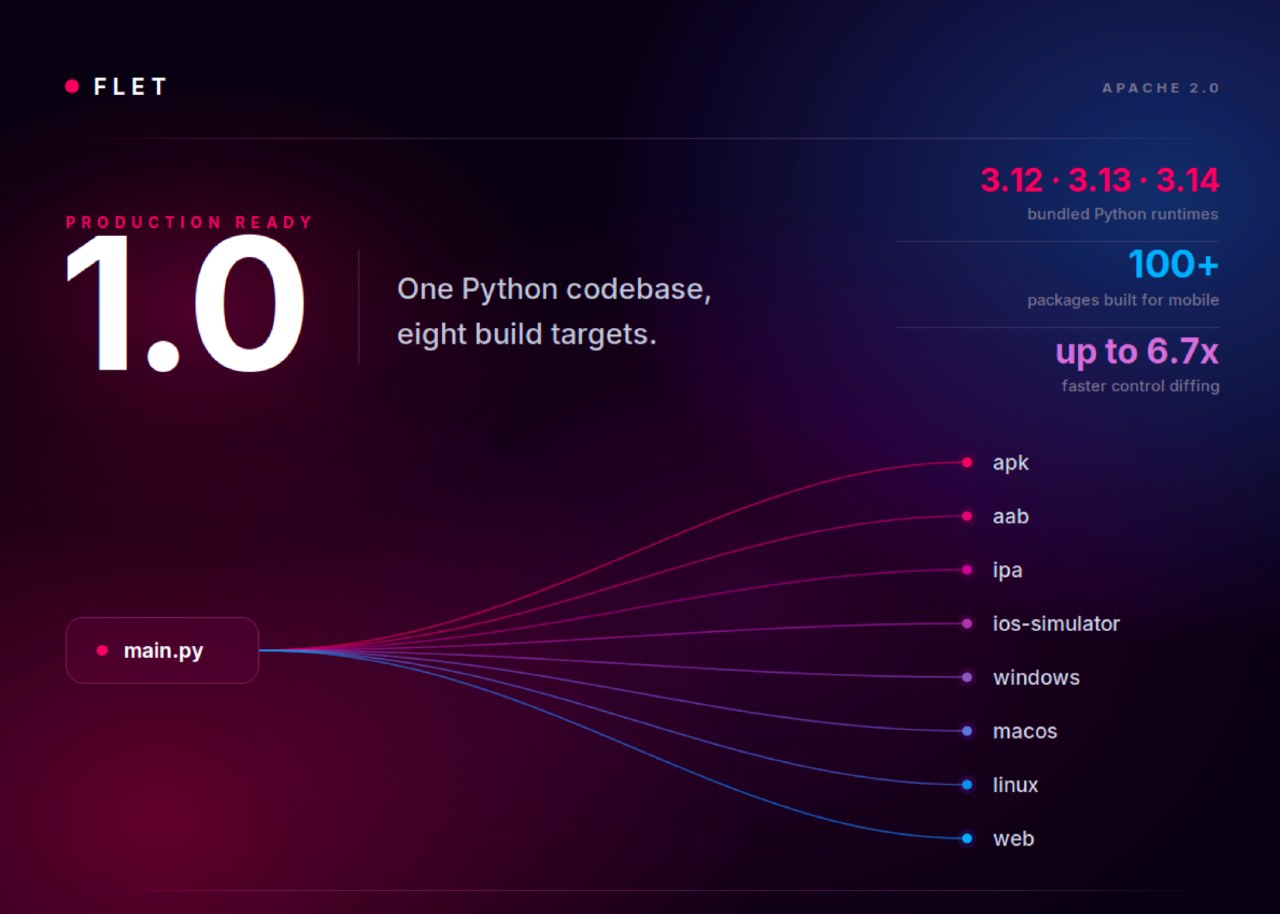
The Flet team has officially launched Flet 1.0, marking the project as ready for production-grade application development four years after its inception. The framework is available on PyPI under the Apache 2.0 license and requires Python 3.10 or newer.
Developers can use the CLI to build artifacts for eight targets, including Windows, macOS, Linux, iOS, Android, and web. The build process supports Python 3.12, 3.13, and 3.14, bundling the chosen version with the application. Web builds utilize the corresponding Pyodide release.
The framework now supports over 100 packages, such as NumPy, pandas, and scikit-learn, through the mobile-forge pipeline. Performance updates include optimized UI reconciliation, which showed up to 6.7x improvement in control diffing during benchmarks.
Flet 1.0 introduces a declarative UI style alongside the existing imperative approach. For mobile and native apps, a dart-bridge facilitates communication between Python and Dart runtimes within a single process, while Android packaging now loads Python packages directly from the APK.
The ecosystem includes an MCP server to provide AI coding assistants with API information and tools. Additionally, Flet Studio features a built-in AI agent and allows users to download projects for local development.



