

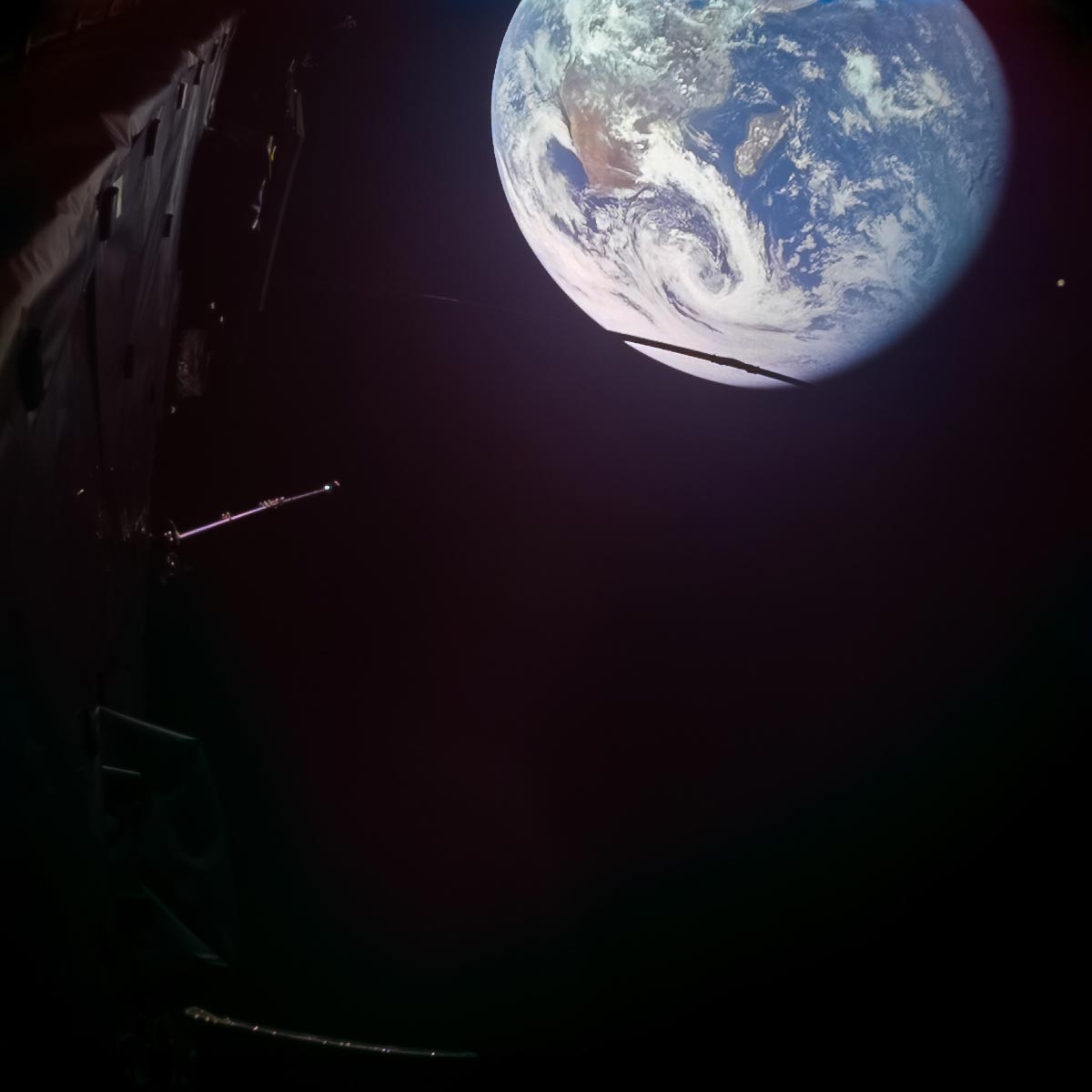
The European Space Agency (ESA) successfully completed a gravity-assist maneuver for the JUICE probe on September 28. The spacecraft passed 8,640 kilometers above the Indian Ocean, utilizing Earth's gravity to adjust its trajectory toward Jupiter. This maneuver increased the probe's velocity by 3.5 kilometers per second and altered its flight path by approximately 20 degrees.
Precise navigation allowed the mission team to minimize propellant consumption, preserving fuel for future operations near Jupiter. During the flyby, the probe captured images of Earth, the Moon, and Madagascar. Scientific instruments, including the JANUS camera, collected data that is currently being analyzed by the research team to calibrate equipment and assess performance in space.
The probe also traversed Earth's magnetotail, gathering data on magnetic fields and charged particles. These findings will be compared with observations from the SMILE mission to study solar wind impacts on the magnetosphere. While in Earth's shadow, the spacecraft relied on battery power, with instrument activity prioritized based on scientific value and operational constraints.
Launched in April 2023, JUICE is on an eight-year journey to Jupiter. The mission plan includes multiple gravity assists from the Moon, Earth, and Venus to optimize fuel efficiency. A final Earth flyby is scheduled for January 2029, with the probe expected to reach the Jovian system in July 2031. The mission will then conduct 35 flybys of Jupiter's icy moons to study their geological and oceanic environments.



