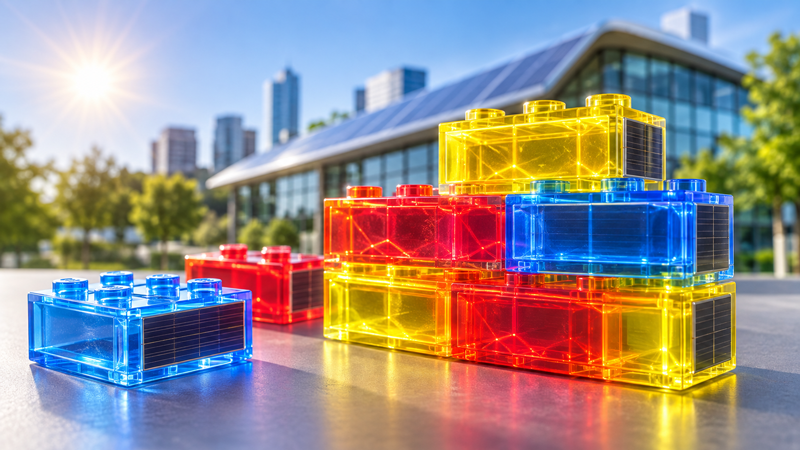
Researchers at Eindhoven University of Technology have developed modular solar blocks named L.E.G.O. (Luminescent Electricity Generating Objects). These blocks are made of transparent polymer with fluorescent dyes that capture light and redirect it to perovskite solar cells attached to the edges.
The technology utilizes both direct sunlight and ambient or artificial light. According to project lead Martijn van Best, red blocks are expected to be more efficient than blue ones. The anticipated energy conversion efficiency is below 10 percent, which is lower than traditional silicon-based solar panels.
The team is currently testing prototypes made of polydimethylsiloxane (PDMS) and developing computer models to analyze optical properties. Researchers are investigating how stacking multiple blocks affects light transmission and electricity generation, while also working on integrating electrical contacts.
The first practical application will be in SparkBlocks educational kits, developed in partnership with the Canadian company Block&Code. These solar modules are intended to replace standard battery packs in children's construction sets to power small electronic devices.
Long-term plans include scaling the technology to create full-sized building blocks for urban infrastructure, such as bus stops, benches, and noise barriers. Currently, there is no set timeline for commercial release or finalized technical specifications.