

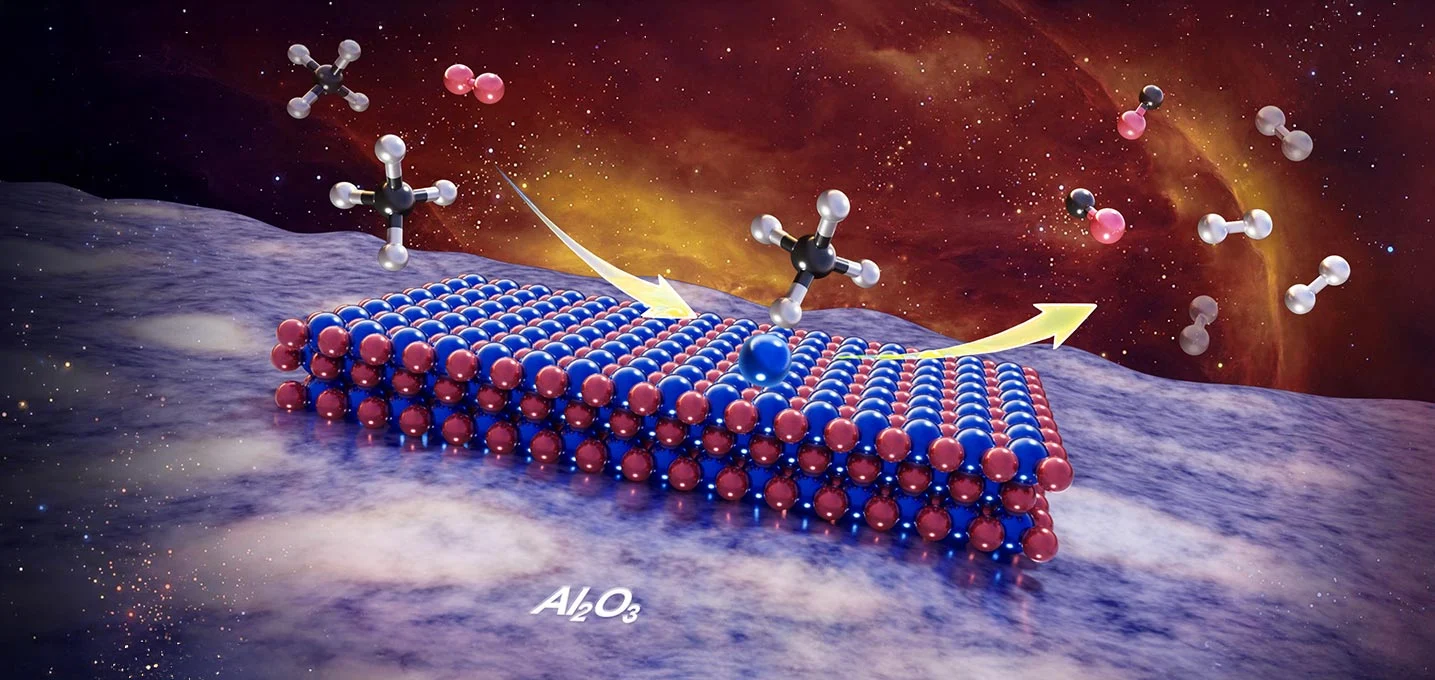
Researchers from the Dalian Institute of Chemical Physics and other institutions discovered that nickel catalysts undergo dynamic restructuring during methane partial oxidation. The study, published in Nature Catalysis, challenges the traditional view that metallic nickel nanoparticles are the primary active sites for this reaction.
The team developed a catalyst with a 0.8% nickel weight ratio, which achieved a 92% methane conversion rate. This catalyst showed performance comparable to a traditional 8.0% nickel catalyst, suggesting that nickel usage could be reduced by a factor of ten while maintaining efficiency.
Theoretical calculations using density functional theory revealed that a specific [Ni1O4Ni4] structure forms on the nickel oxide surface during the reaction. This dynamic structure lowers the activation energy for breaking methane C-H bonds to 12.5 kcal/mol, compared to 15.7 kcal/mol for metallic Ni(111).
The findings emphasize the importance of in-situ characterization under real reaction conditions, as catalysts are not static. Designing materials that actively restructure into optimal configurations during operation could significantly reduce metal consumption and production costs in industrial catalysis.


