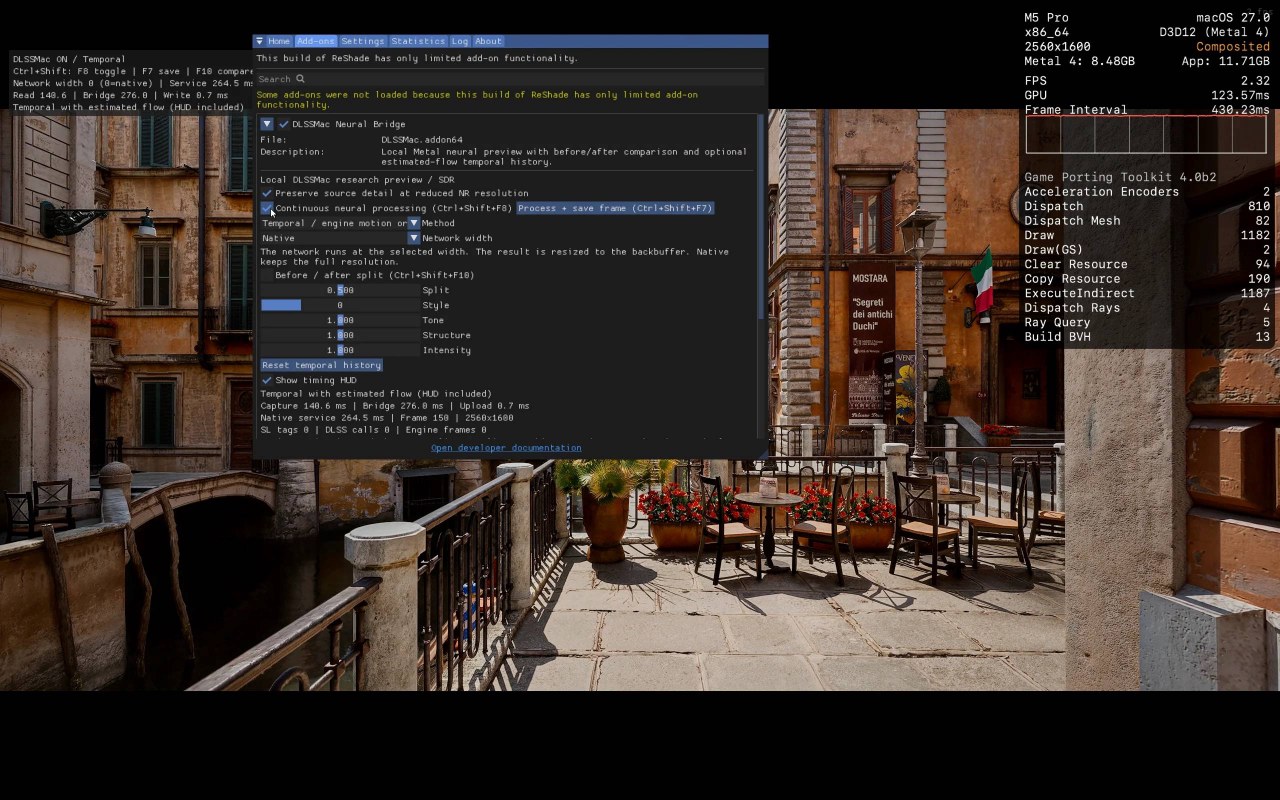
The test was led by developer @iamwavecut, who ported the DLSS 5 neural rendering model to the Apple Silicon platform using the Apple Metal framework. Developer @Mappsnet7 integrated the Metal backend into the Windows gaming environment via ReShade and Game Porting Toolkit 4.0b2.
In terms of performance, the M5 Pro's 16-core GPU achieved a significant improvement in surface lighting, ambient occlusion, and depth of field realism, enhancing overall image detail and stereoscopic effect.
However, performance metrics were disappointing. At 1440p resolution, the frame rate dropped to 2.32 FPS, and input lag increased to 240 milliseconds, which is ten times higher than that of a desktop RTX 5050.
The performance collapse is attributed to the M5 Pro's lack of dedicated FP8 hardware units. DLSS 5's core calculations depend on FP8 precision, while the M5 Pro must route neural rendering loads to FP16 paths, resulting in no performance gain.
Comparing specifications, the M5 Pro's 16-core GPU supports a maximum of 26 TOPS of FP8 compute power, while the desktop RTX 5050 reaches approximately 105 TOPS. Additional overhead from running neural inference through ReShade and GPTK4 further hindered performance.