

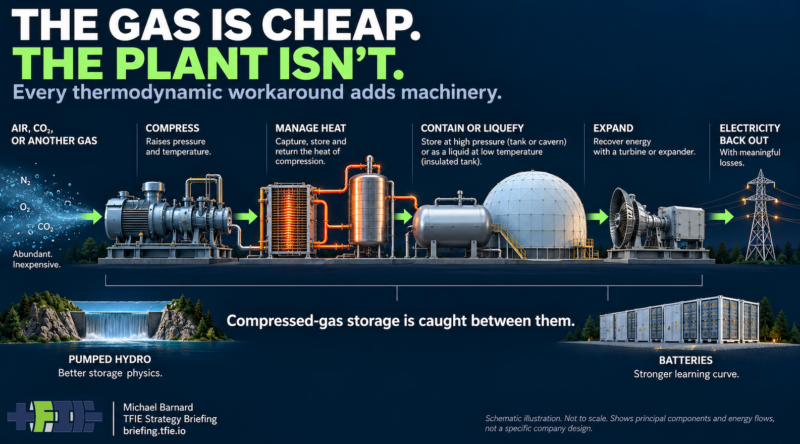
Recent years have seen the commissioning of several large-scale compressed-gas energy storage projects. China launched a 600 MW / 2.4 GWh compressed-air demonstration plant in Huai’an. Hydrostor is advancing its 500 MW / 4 GWh Willow Rock project in California, while Highview Power is constructing a 50 MW / 300 MWh liquid-air facility. Additionally, Energy Dome is developing a 20 MW / 200 MWh CO2 battery in Sardinia.
Despite the increased scale of these demonstrators, the technology faces economic challenges compared to batteries and pumped hydro. The IEA reported that global battery energy storage system prices in 2025 dropped to one-third of their 2020 levels. In contrast, compressed-gas storage requires significant civil engineering, excavation, and site-specific construction, which limits the potential for manufacturing-driven cost reductions.
Efficiency remains a key hurdle for these systems. The California Energy Commission estimates the round-trip efficiency of the Willow Rock facility at approximately 60%. Systematic reviews from 2025 indicate that standalone liquid-air storage systems generally operate at 50%–60% round-trip efficiency, often requiring integration with external industrial processes to improve economic viability.
Energy Dome claims a round-trip efficiency exceeding 70% and a plant lifetime of over 30 years with no capacity degradation. However, these figures lack long-term operational history. The Sardinian facility currently relies on support from the European Investment Bank and public-policy capital, which is typical for first-of-a-kind technology development rather than established commercial competition.



