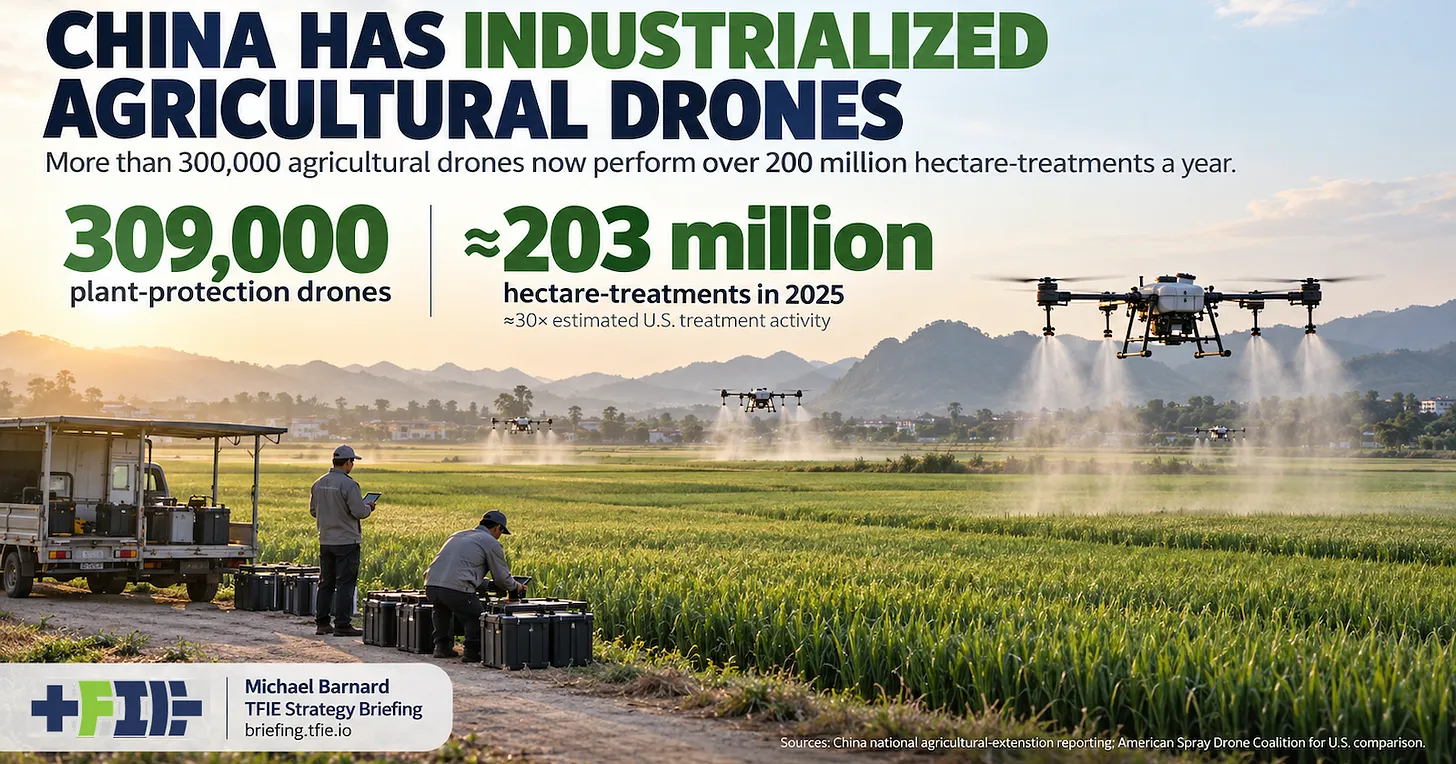
China entered 2026 with approximately 309,000 plant-protection drones, which performed about 203 million hectare-treatments in 2025. This represents an increase of 58,000 aircraft and 25 million treatments compared to 2024, when the country operated 251,000 drones and recorded 178 million treatments.
In contrast, the United States market remains significantly smaller. According to the American Spray Drone Coalition, operators performed about 6.64 million hectare-treatments in 2025. Despite the difference in scale, both countries possess a comparable amount of cultivated land, with China at 128 million hectares and the U.S. at 133 million hectares.
The data indicates that China conducts roughly 30 times more agricultural drone work than the U.S. While the American market is experiencing rapid percentage growth, the sheer volume of China's established fleet allows it to add more annual activity in absolute terms than the entire U.S. market currently handles.
The adoption of drones in the U.S. suggests that the technology addresses specific agricultural challenges, such as treating tall crops, accessing wet fields, or navigating irregular parcels. These benefits persist even in highly mechanized systems that already utilize large tractors and crewed agricultural aviation.
The disparity in deployment between China and other regions, such as Europe, suggests that hardware availability is not the sole driver of industry growth. Success depends on integrating drones into existing regulatory frameworks, contracting models, and agricultural operations, moving beyond pilot programs to mature, large-scale usage.