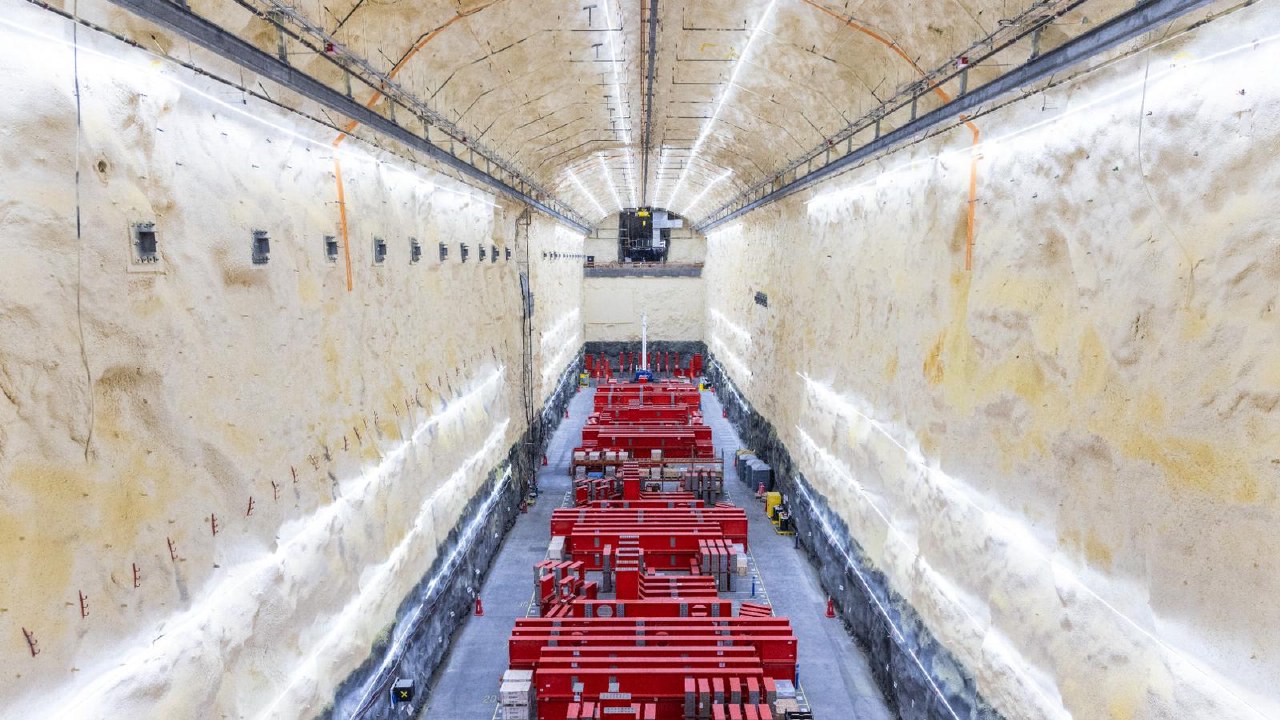
CERN, Fermilab, and the Sanford Underground Research Facility have begun assembling massive cryostats for the Deep Underground Neutrino Experiment (DUNE). The facility is located nearly one kilometer underground in South Dakota. Each cryostat measures 65.8 meters in length and 18.9 meters in width, designed to hold 17,000 tons of liquid argon cooled to -300 degrees Fahrenheit.
The project involves firing a neutrino beam 1,300 kilometers from the Fermilab accelerator in Illinois to the underground detectors. Scientists will measure the beam near the source and again after it passes through the Earth to study matter and antimatter symmetry. The assembly process, which began in November, involves lowering over 2,600 steel beams to a depth of 1,478 meters.
CERN is providing over 6,200 tons of steel and managing the design, logistics, and installation of the cryostats, marking its first major project outside Europe. A team of 1,500 scientists from five US Department of Energy laboratories and CERN is coordinating the effort. The underground complex preparation is set for 2029, with detector installation in 2030 and the scientific cycle starting in 2031.
The research program will utilize the upgraded PIP-II accelerator at Fermilab and is scheduled to run through the late 2040s. The infrastructure will enable continuous monitoring of neutrino flows from the Sun, supernovae, and cosmic rays, providing a long-term environment for fundamental physics research.