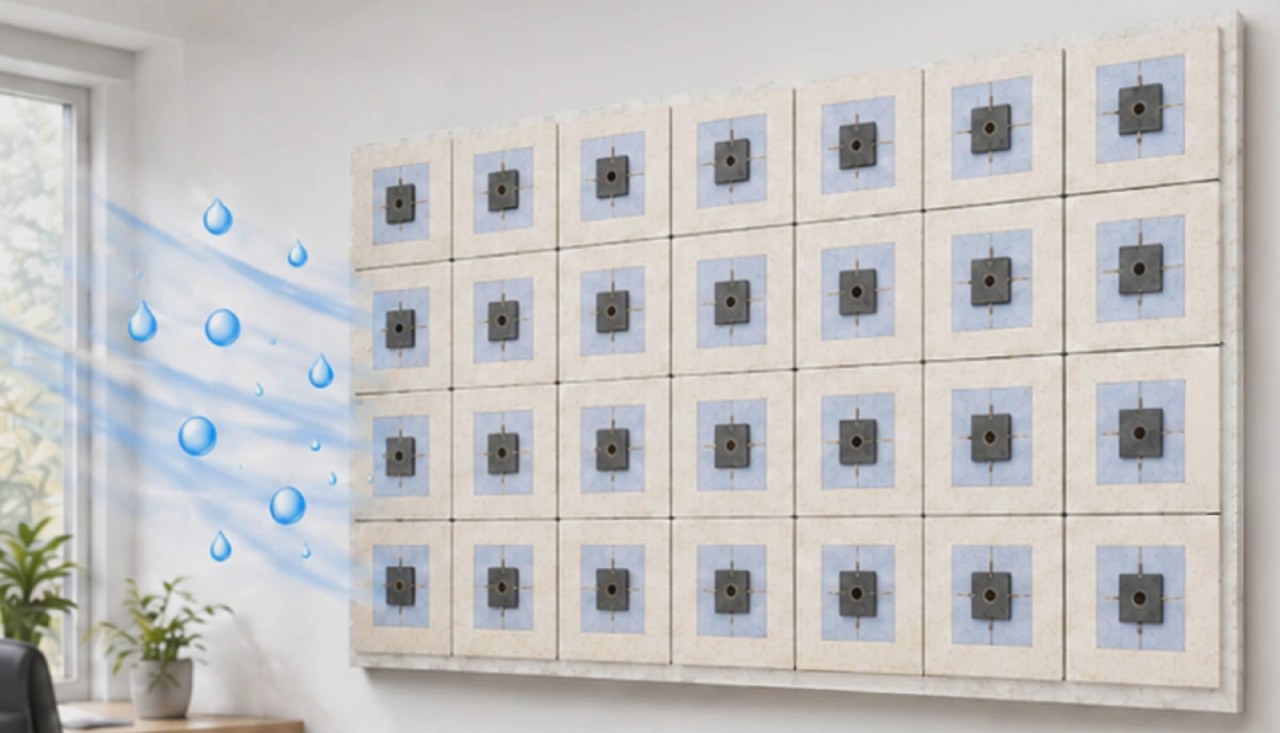
Researchers at Binghamton University, State University of New York, have developed a paper-based wallpaper that generates electricity from indoor humidity. The prototype, detailed in Advanced Energy Materials, uses chromatography paper 340 micrometers thick to absorb moisture and regulate indoor humidity levels.
Each 2-square-centimeter unit features a glycerol-coated edge for moisture absorption, a PVP-filled middle for water transport, and a wax-treated center to control evaporation. Graphite ink electrodes collect the current generated by proton movement caused by ion concentration gradients. At 80% relative humidity, a single unit produces 0.34 volts with a power density of 2.2 microwatts per square centimeter.
The team demonstrated the technology by powering a wireless keyboard using an array of 1,596 units and a capacitor. In humidity control tests, 28 units reduced humidity from 75% to 50% within 4 minutes in a sealed chamber. The wallpaper is designed for low-power IoT devices rather than replacing traditional power grids.
While the researchers aim to utilize printing processes like screen printing and laser processing for future production, the project remains at the laboratory prototype stage. Current limitations include unproven long-term durability, stability, and performance in real-world residential ventilation conditions.