

Researchers at the Australian National University have developed specialized optical coatings for the upgraded LIGO gravitational wave detectors. The project, which took three years to complete, resulted in two optical elements designed to minimize noise caused by microscopic surface defects.
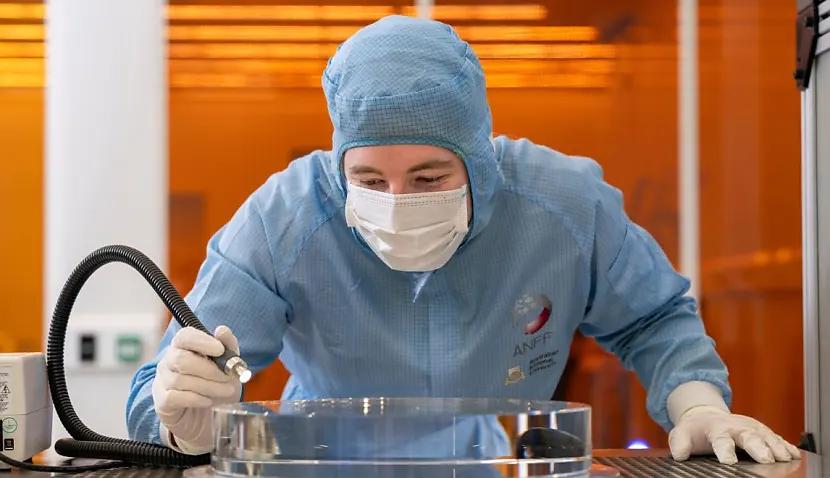
Each beam splitter is a 45-centimeter glass disk weighing over 20 kilograms. One side features a high-precision beam-splitting coating, while the other has an anti-reflective layer that is over 1000 times more effective than standard eyewear lenses. The manufacturing process requires thickness control within 1–2 nanometers across the entire surface.
To achieve this precision, the team built 8 automated systems for non-contact handling and cleaning. Production takes place in a cleanroom at the ANU Research School of Physics, which meets standards comparable to semiconductor manufacturing. The university is one of only two groups globally capable of producing such components.
These upgrades aim to enhance the sensitivity of LIGO to detect weaker signals from distant black hole and neutron star collisions. By reducing interference at the atomic level, the new coatings allow for more precise observations of cosmic events, building on the first gravitational wave detection achieved in 2015.

