AMD has introduced a tetrahedral cages technology designed to optimize memory usage and computational power during ray tracing in complex animated scenes. The method allows for real-time ray tracing of hundreds of millions of independently animated triangles by avoiding the traditional overhead of bounding volume hierarchy (BVH) structures.
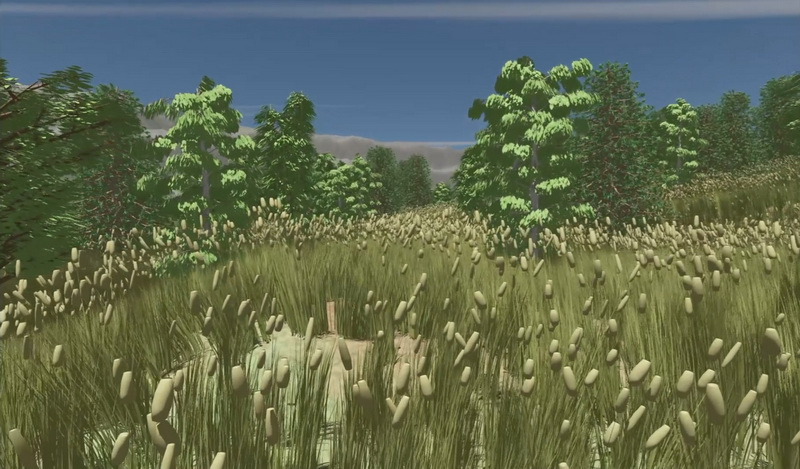
In a demonstration published on GPUOpen, the company showcased a scene featuring 25,000 animated plants totaling 2.8 billion triangles. Using the new approach, the system processed 500 million triangles at over 60 FPS in 1080p resolution on a Radeon RX 9070 XT graphics card.
The technology works by enclosing dense geometry within deformable tetrahedral cages. This allows the underlying geometry and its BVH to remain static and reusable, while only the surrounding cage is animated. This results in a 47-fold reduction in memory usage for acceleration structures, dropping from 80 GB to 1.7 GB.
Furthermore, the method achieves a 90-fold reduction in BVH update times compared to traditional approaches. While highly efficient for foliage, crowds, and distant objects, the technology is less suitable for detailed vertex-level animations like facial expressions due to its inherent limitations in handling complex mesh deformations.
The research, titled 'Ray Tracing Massive Amounts of Animated Geometry,' received the Wolfgang Straßer Best Paper Award at the High-Performance Graphics 2026 conference. AMD is currently providing a header-only C++ library and DXR integration examples to assist developers in adopting this method.