

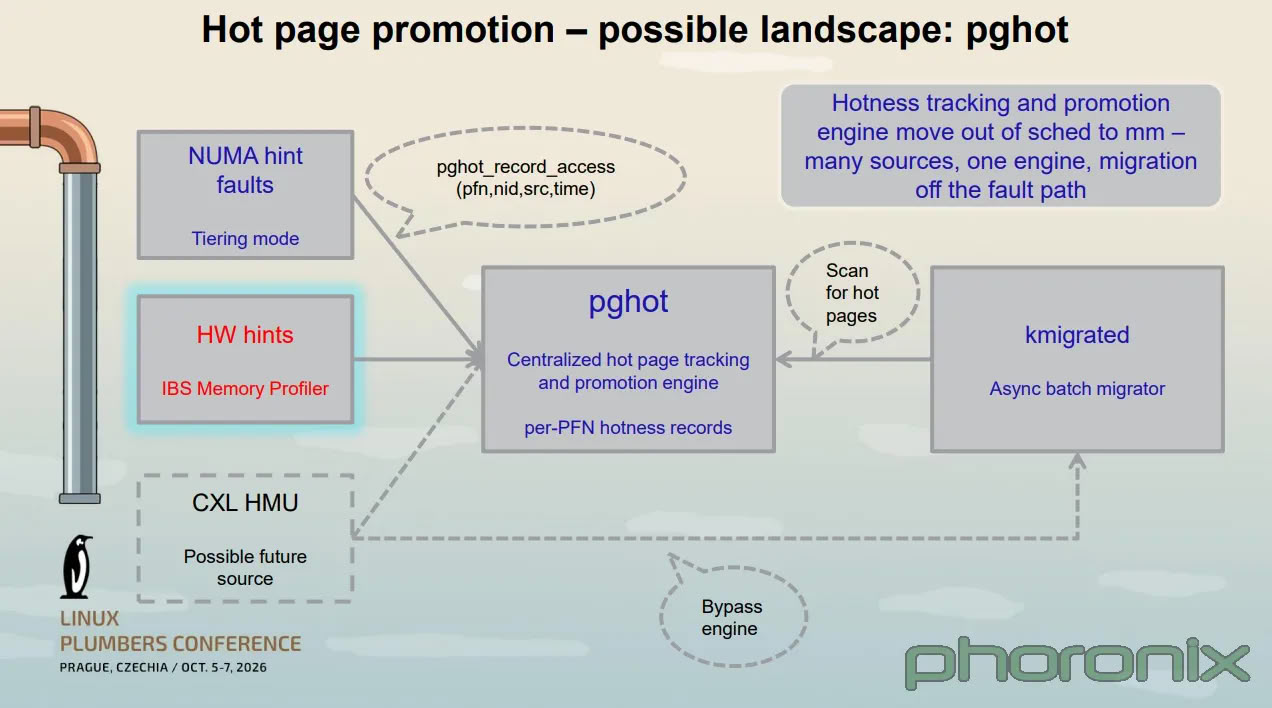
AMD engineer Bharata Bhasker Rao presented the IBS Memory Profiler for Zen 6 processors at the Linux Plumbers Conference 2026 in Prague on October 5. This hardware feature samples data memory accesses, providing the kernel with physical addresses and information on whether data originated from DRAM or external memory like CXL.
The technology aims to assist Linux in managing tiered-memory servers by identifying frequently used pages for migration from slower CXL memory to DRAM. AMD intends to integrate these profiler samples into pghot, a proposed kernel subsystem for tracking hot pages, which would replace current methods involving page table scanning and page fault trapping.
Internal AMD testing on a system with 256 logical CPUs and 256 GB of CXL memory showed performance improvements for specific workloads. XSBench achieved a 4.57x speedup compared to 1.18x with the current method, while Graph500 reached 3.17x versus 2.34x. However, Redis showed no gains, and NAS BT performance slightly declined.
Additional tests indicated that per-folio promotion costs decreased from 26.1 to 15.8 microseconds, although the benchmark itself ran 5% slower. The current pghot patches remain in development, and the slides do not mention virtualization support for the profiler. EPYC 9006 Venice chips are currently in production, with cloud deployments planned for later this year.



