

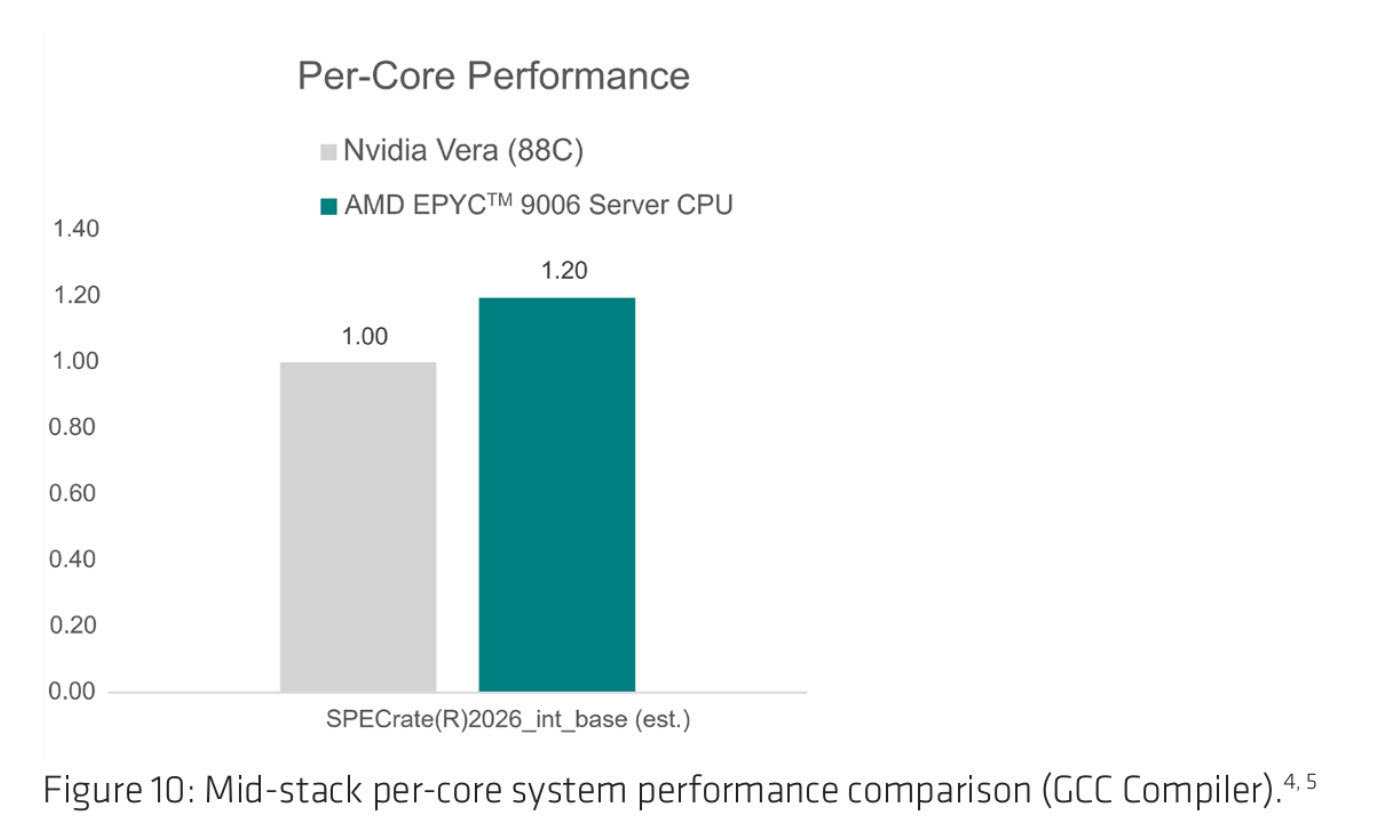
AMD has released a technical white paper for its sixth-generation EPYC 9006 Venice server processors. The document highlights performance metrics across data centers, cloud computing, and agentic AI workloads, comparing the new chips against Nvidia's Vera and Intel's Xeon 6980P platforms.
The flagship 256-core EPYC 9996 processor reportedly delivers 2.24 times the performance of Nvidia's 88-core Vera and 2.37 times that of Intel's Xeon 6980P in SPECrate 2026 Integer tests. Compared to the previous 192-core EPYC 9965, the new generation shows a 78% performance increase.
In specific workloads like Java, OpenSSL, MongoDB, and Redis, AMD claims the EPYC 9996 outperforms the Xeon 6980P by 2.4 to 3.7 times. For high-performance computing tasks such as molecular dynamics and weather forecasting, the lead reaches up to 3.13 times.
AMD introduced a rack-level performance model based on a 100 kW power budget. Under these conditions, the Venice-based platform is estimated to provide 3.3 to 3.4 times the throughput of the Nvidia Vera solution. Additionally, the Venice platform shows an 18% advantage in total memory bandwidth.
Industry analysts have raised questions regarding the testing methodology. Concerns include the use of a 96-core Venice chip with a 600 W power budget, potential compiler version discrepancies between GCC 16.1 and GCC 15.2, and the reliance on extrapolated data for some Nvidia Vera performance figures.



