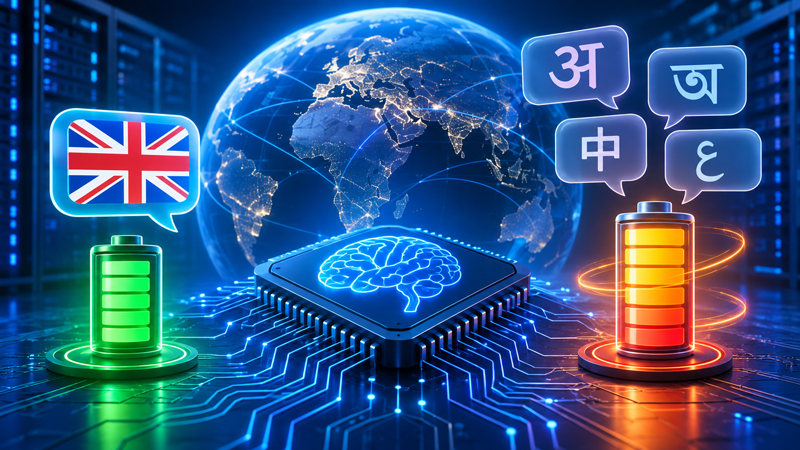
Researchers from the University of Michigan found that AI models consume significantly more energy when processing non-English queries. Depending on the language and the model, energy consumption can be 1.4 to 180 times higher than for English.
The study analyzed 122 languages using models including Alibaba's Qwen 3, Google's Gemma 3, and Meta's Llama 3.1. The team utilized their custom ML.Energy system to measure power consumption on NVIDIA L40S and RTX 6000 Pro Blackwell GPUs.
The energy disparity stems from tokenization inefficiencies and longer output lengths for languages with fewer training resources. Some languages require up to 25 times more output tokens than English, which reduces GPU efficiency and increases memory demands.
Data shows that processing queries in Pashto can consume 3147 kJ compared to 17.6 kJ for English. Languages like Hindi and Bengali require 7.9 and 15.3 times more energy respectively, while many Western European languages show a twofold increase.
Approximately 5.2 billion people speak languages that require at least double the energy for AI processing compared to English. This energy gap could lead to higher costs for users and discourage companies from supporting specific languages.
To mitigate these issues, researchers suggest optimizing models for specific languages, routing queries to specialized models, or using high-quality translation to English before processing. Expanding training datasets with more diverse language materials is also recommended.