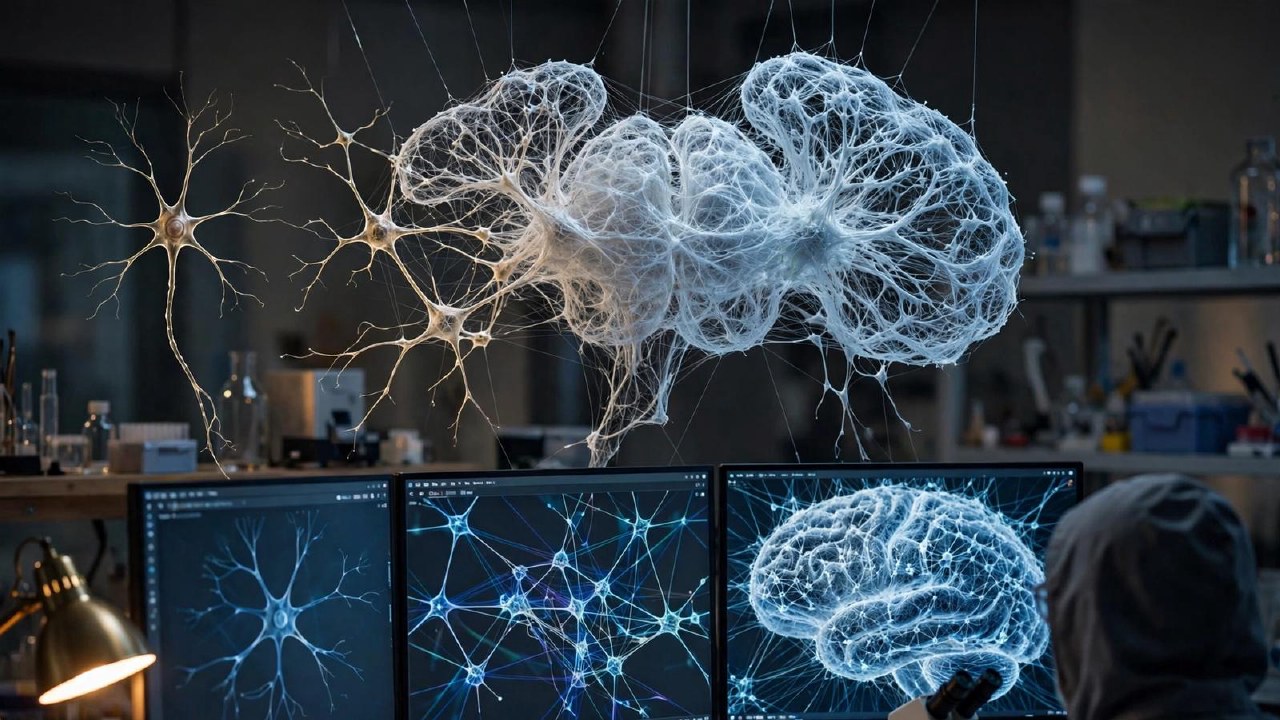
Researchers from the ELLIS Institute and the University of Tübingen have detailed how AI automates scientific modeling. The process involves three stages: model construction, parameter tuning, and result interpretation. AI has shown significant progress in adjusting models based on experimental data.
Historically, the Hodgkin-Huxley model, developed in 1951, required over three weeks of manual calculations on a mechanical calculator. Today, AI can perform similar tasks in a few hours using simulation-based inference. This method requires approximately 100,000 simulations for simple models and millions for complex systems.
The AI approach generates a distribution of probable parameters rather than a single set. Researchers propose using AI agents to draft equations, write code, run simulations, and refine models based on data. Simple models that fit the data are prioritized over complex ones with excessive parameters.
Over the past two years, several studies have demonstrated LLMs designing scientific models, though these were mostly tested on known problems. Challenges remain in automating result interpretation and proving that AI can identify explanations for entirely new phenomena.
The proposed methodology focuses on creating a set of consistent explanations rather than a single model. For complex systems like the fruit fly brain, which contains over 100,000 neurons, AI helps identify where uncertainty persists and which future experiments are necessary to resolve it.