

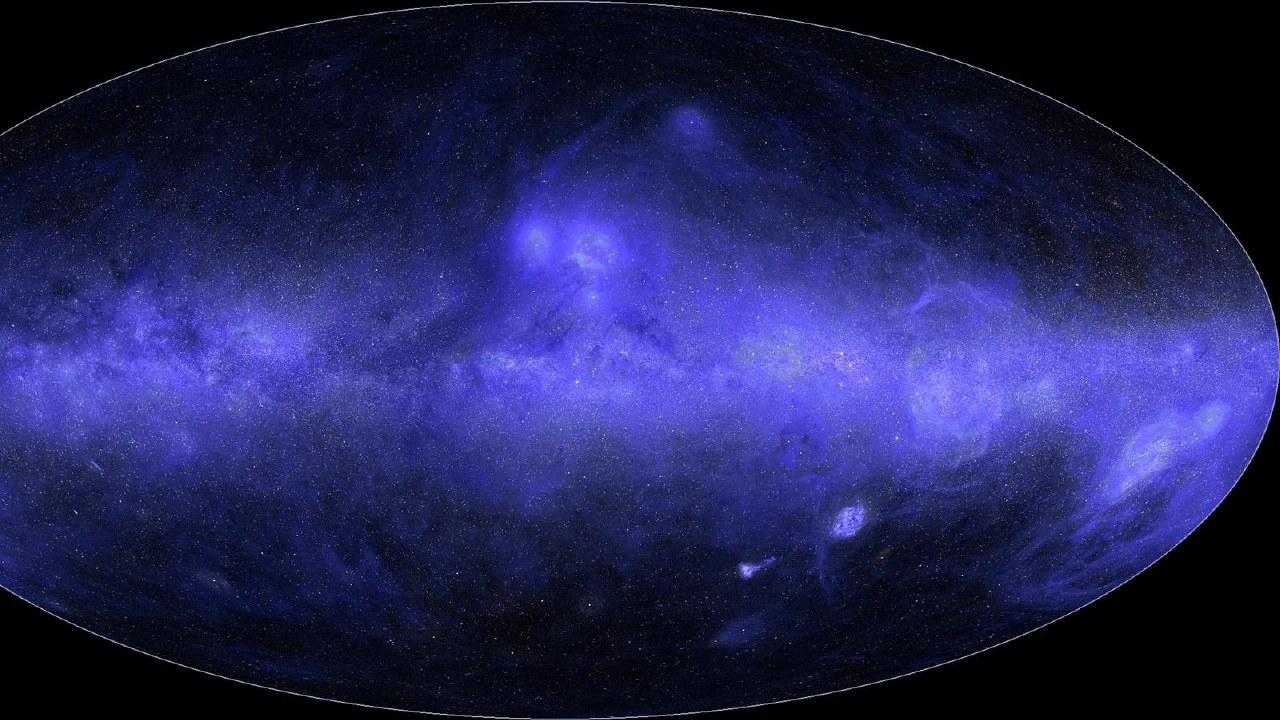
Astrophysicist Brice Menard from Johns Hopkins University, in collaboration with Claude Science, has generated the first complete ultraviolet map of the entire sky. The map visualizes dust clouds illuminated by young stars and remnants of stellar explosions within the Milky Way. Previous efforts, such as NASA's GALEX mission, covered only about two-thirds of the sky and excluded dense galactic regions.
The project utilized AI agents to aggregate and process astronomical data from multiple sources. These agents performed cross-calibration and unified various observations into a single coordinate system. To address data gaps, the model predicted missing ultraviolet fragments by correlating them with existing optical, infrared, and radio observations. The model's predictive accuracy was verified by masking known data, resulting in a 10% deviation from actual values.
The AI processed 38,000 individual observations collected by the GALEX satellite between 2003 and 2013. During the refinement process, the agents identified and corrected artifacts caused by residual atmospheric glow. The final map also incorporates ultraviolet radiation estimates for over 100 million stars, derived from data provided by the European Gaia satellite.
The team produced over a dozen versions of the map within a few days of collaborative work. This project demonstrates the capability of AI agents to automate the labor-intensive processing of large scientific datasets. The resulting map serves as a tool for studying young stars, interstellar dust, and the aftermath of stellar explosions.



