

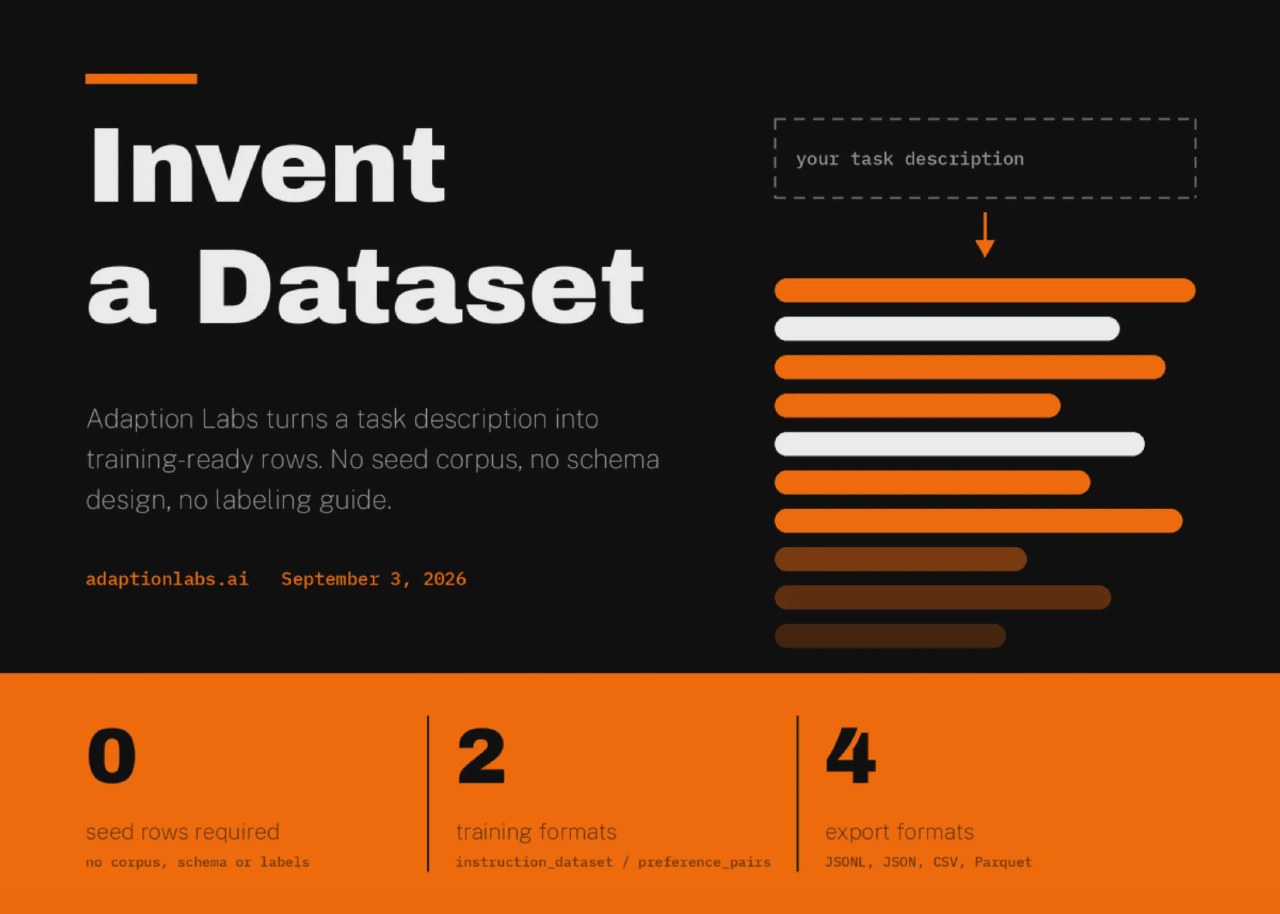
The tool allows users to generate training data based on a task description rather than a seed corpus. It is available through the Adaption app, a Python SDK, and a REST API. The resulting data can be downloaded in JSONL, JSON, CSV, or Parquet formats. Generation is hosted on Adaption's platform and requires credits.
Users control the process using domain codes, which can be fetched via datasets.invent_domains. For example, the 'medical' domain can be narrowed down to 'medical.symptoms_diagnosis'. The system supports two output formats: 'instruction_dataset' for supervised fine-tuning and 'preference_pairs' for preference-based training like DPO.
Production parameters include a prompt of up to 10,000 characters and an idempotency_key of up to 255 characters. The 'language_expansion' feature offers two modes: 'translate' for new row variants in target languages and 'localize' for country-specific wording. A sample_rate between 0.01 and 1 determines the fraction of rows to be expanded.
The workflow integrates with AutoScientist, launched in May 2026, which optimizes data and training recipes. Adaption reports that AutoScientist outperforms human-configured training by an average of 35%, with win rates increasing from 48% to 64%. These results are based on evaluations across eight verticals with dataset sizes from 5,000 to 100,000 rows using Together AI architectures.



