

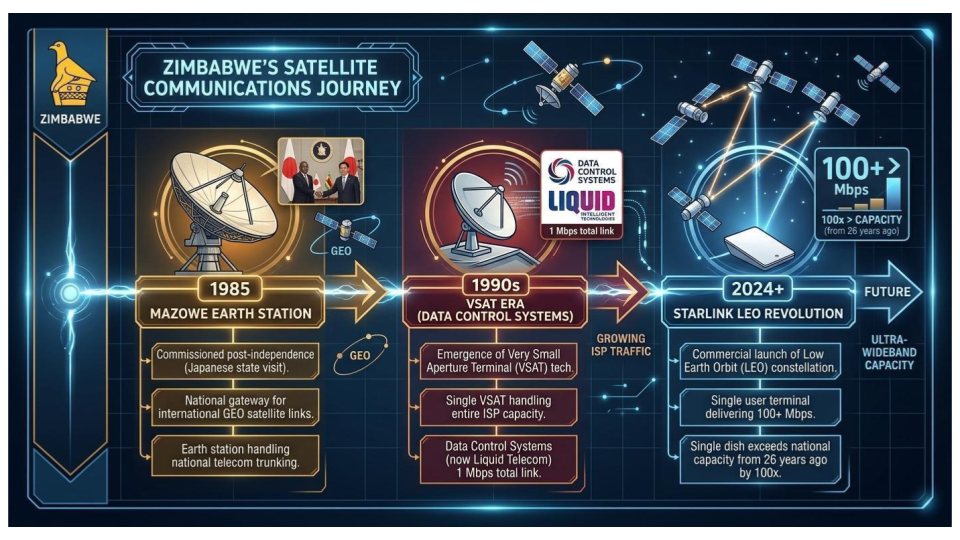
Zimbabwe plans a twelve-month roadmap to integrate Starlink LEO satellite infrastructure with its existing terrestrial fibre networks. The project involves constructing domestic gateway teleports, obtaining Q/V band licensing, and establishing a Point of Presence in Harare.
The initiative aims to address bandwidth bottlenecks and maintain domestic latencies below 20 ms. The strategy requires high-frequency feeder allocations in the Q/V band, in addition to standard Ku and Ka bands, to connect satellite constellations with ground networks.
The Harare Point of Presence will integrate with several existing fibre backbones. Liquid Intelligent Technologies operates over 26,000 km of fibre, while PowerTel and Paratus have deployed an 800 Gbps link between Plumtree and Bulawayo, with a total capacity of 10 Tbps.
DFA Zimbabwe has built a 1,500 km open-access optical fibre backbone through a partnership with BCS Group and Dandemutande valued at over $18 million. This network uses DWDM technology to connect major cities and cross-border transit points.
The project also includes connecting the local Starlink infrastructure to the Google Umoja cable system to provide low-latency intercontinental cloud access. The deployment is structured into three phases, covering regulatory clearance, construction, and service launch.



